

Lou Reed's Nephew: The Collages
How they came to be.

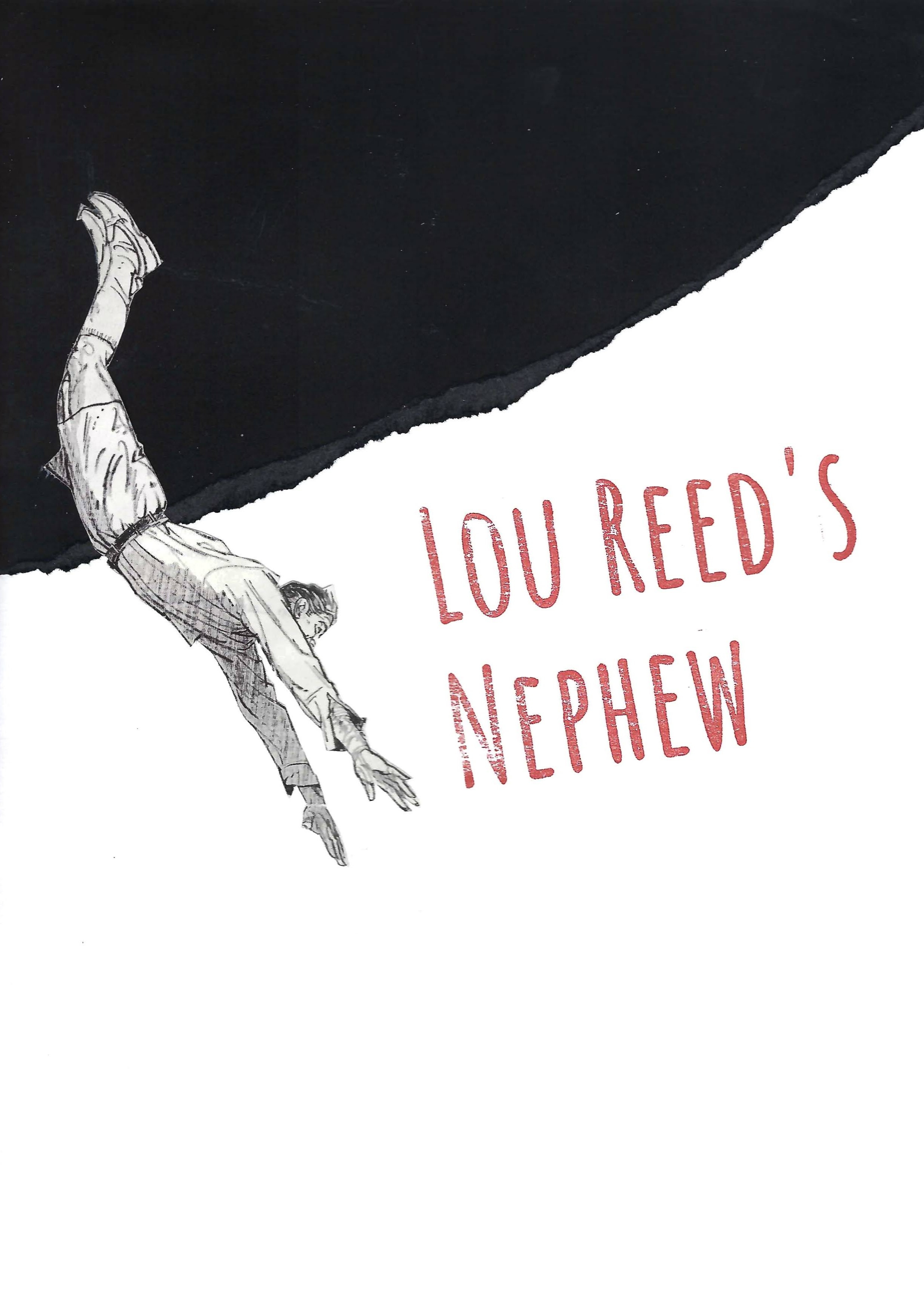
(Author’s Note: Last month, Josh Glenn at HiLoBrow invited me to curate a series of my collages, with commentary. I’d been wanting to write about how I accidentally became a collagist, so I was grateful for the opportunity. The following is a version of that series.)
“Lou Reed’s nephew,” the phrase, has been with me since at least 2012. I had been introduced to Diderot’s satirical dialogue Rameau’s Nephew twenty years before via its brief appearance in Hegel’s Phenomenology of Spirit. Hegel uses it to illustrate “disrupted consciousness,” which produces “clever and witty” talk, “a rigamarole of wisdom and folly,” a form of consciousness I strongly identify with both myself and my generational cohort. I’m not sure how long I thought about it before I realized whose nephew this would have to be today, but you see what I decided.
As I later discovered, I am not even the first person to use the phrase as a metonym for a certain feeling of … disappointment. Describing The Strokes on a message board in 2001, user “Omar” wrote: “On the voice: the guy sounds like Lou Reed’s nephew, which comes down to being a fake of a fake. Mmm, now they sound interesting again :)”
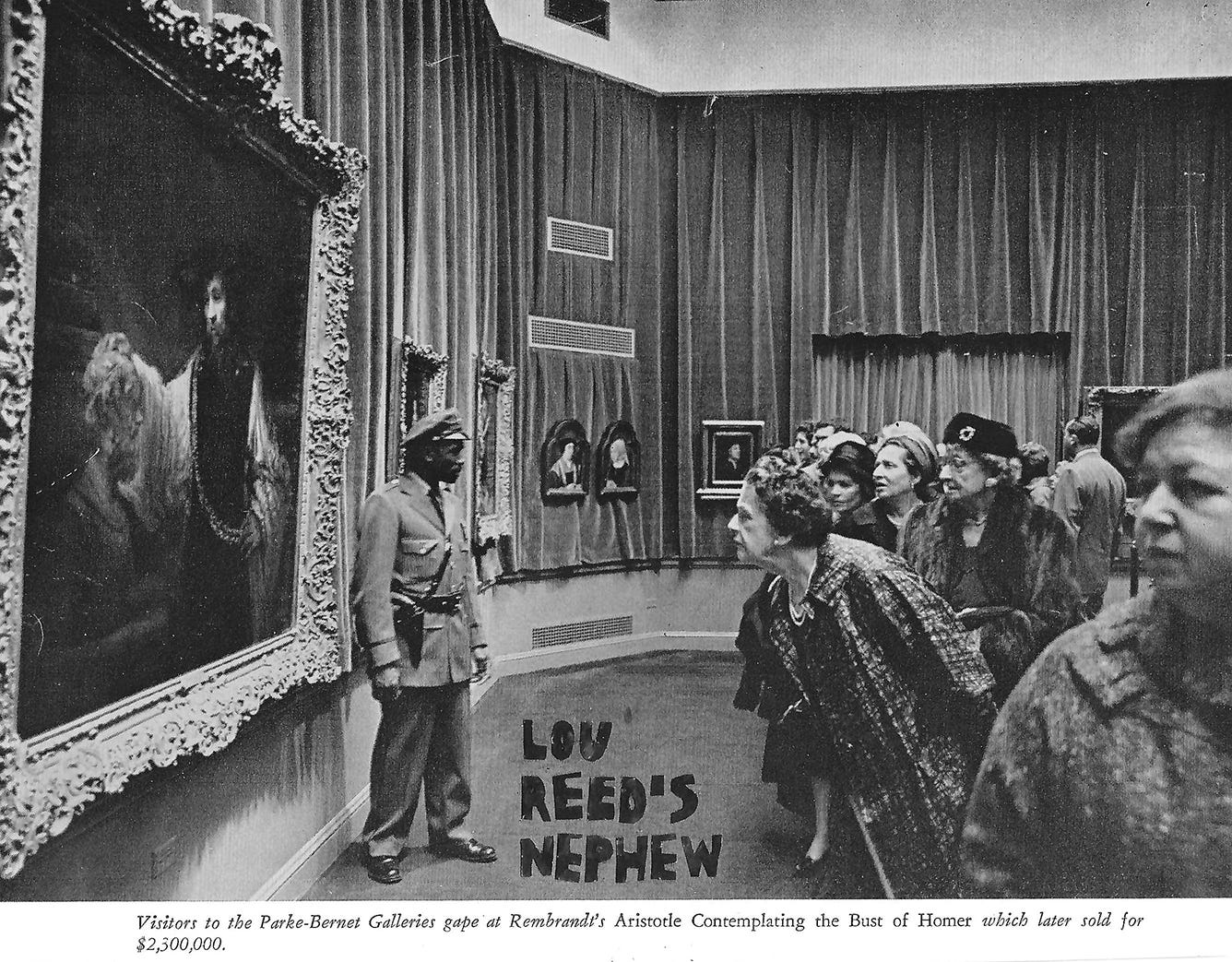
The phrase turned into a series of vignettes about work, art, and tech, which I started posting on Medium in 2012, losing steam with the death of the historical Lou Reed on October 27, 2013. The collages came much later, spontaneously, when I released the long-gestating manuscript to my agent in early 2022. I was sick of words. My wife had been cutting things up and pasting them back together as long as I’d known her. I simply joined in. “Lou Reed’s nephew” had become such a character in our lives that she made what is arguably the first L.R.N. collage by applying block letters to an early-1960s magazine photo with a recursive caption that cannot be improved. It reads: “Visitors to the Parke-Bernet Galleries gape at Rembrandt’s Aristotle Contemplating the Bust of Homer which later sold for $2,300,000.” A copy of a copy of a copy of a copy, guarded by a slouching subject in an ill-fitting uniform (see Fig. 1).
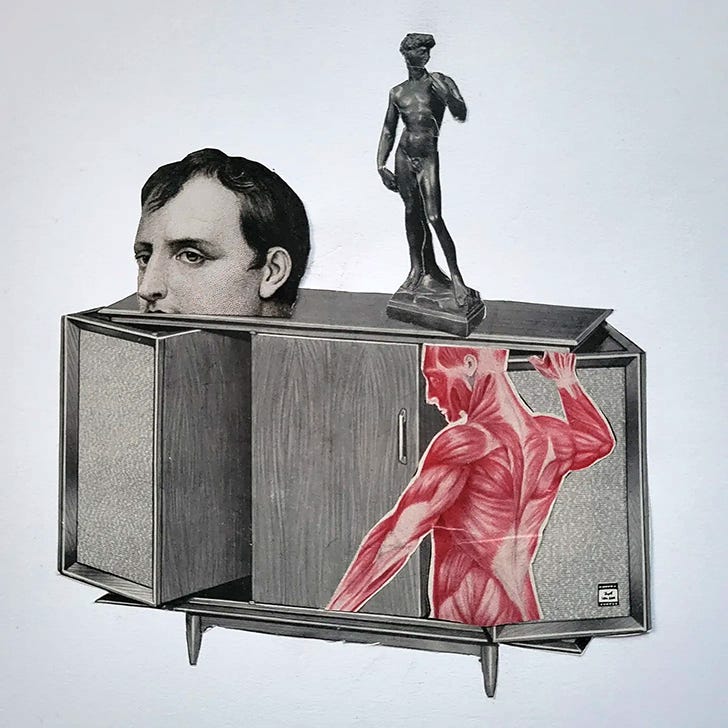
Having never attempted visual art—other than some pre-teen hours spent with How to Draw Comics the Marvel Way and a life drawing class at F.I.T., where the instructor wrote “older” next to my name on the roll—I became intrigued by how images change via proximity to one another, and just how delicate an operation it is to peel them from their contexts. How much Napoleon is enough Napoleon to maintain Napoleon? (Fig. 2)
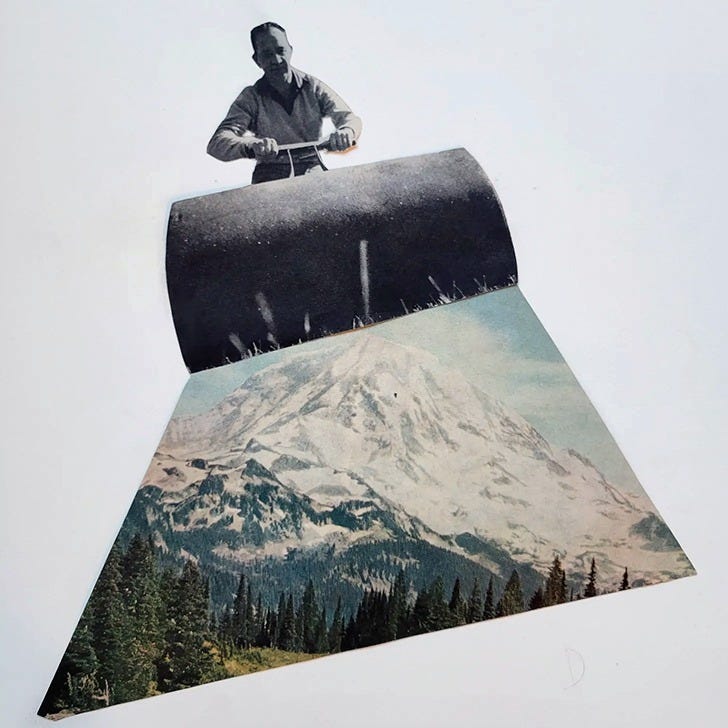
How is it that two pieces of paper placed together—only because their edges accidentally line up—suddenly tell a story and practically give a lecture? (Fig. 3)
Why does a deliberate crop that created a decapitated man—in this case, from an ad for bowling balls—feel perfectly balanced (even torn from context) in a way that an image decapitated by the collagist does not, no matter how hard I try? (Fig. 4)
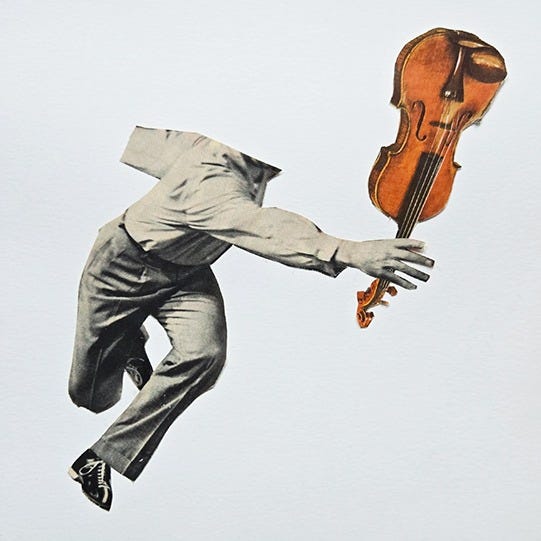
After a year of collaging, I decided to serialize Lou Reed’s Nephew here on Substack, having given up hope on respectable publication. I was surprised to find that no matter what the chapter was about, I had a collage that went with it.
The image below (Fig. 5), for example, is a much stranger and more appropriate illustration for Episode 34, “Antigone: The Last Recommendation Engine,” than I would have ever come up with deliberately. The vignette reads, in part:
She fumbled inside the large, fashionable bag she had brought with her and retrieved an object I had never seen before. It was a translucent sphere the size of a softball. She also pulled a small circular pedestal from the bag. She placed this on the table between us and set the sphere on top of the little stand so it wouldn’t roll away.
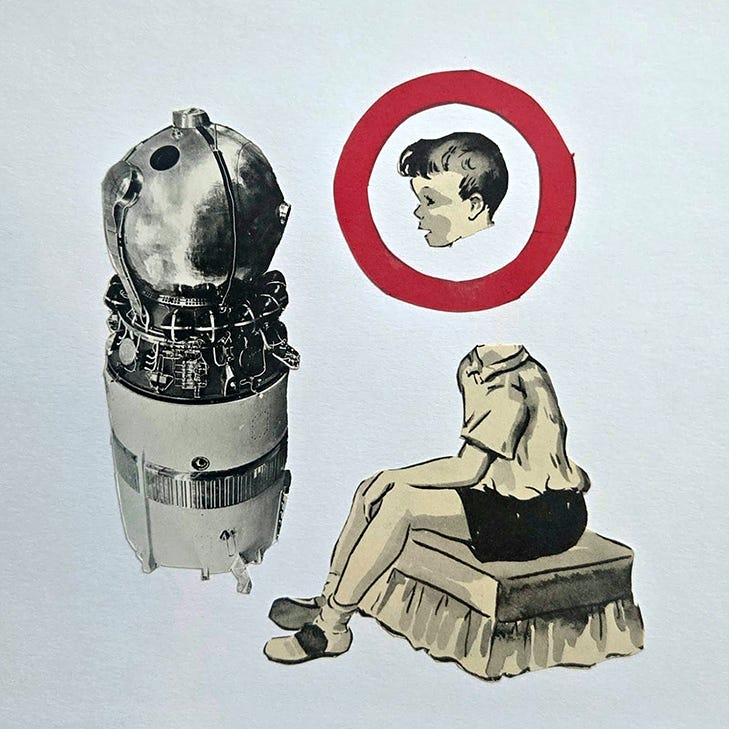
How can this be? Is it because even with all the freedom and randomness I can muster, there remains a narrow structure of the self—a transcendental unity of apperception—that restricts me to a thin band of concerns? A structure, like the one Merleau-Ponty describes in The Structure of Behavior, that makes my handwriting look similar on a blackboard and on paper, even though completely different muscles are involved? (Fig. 6)
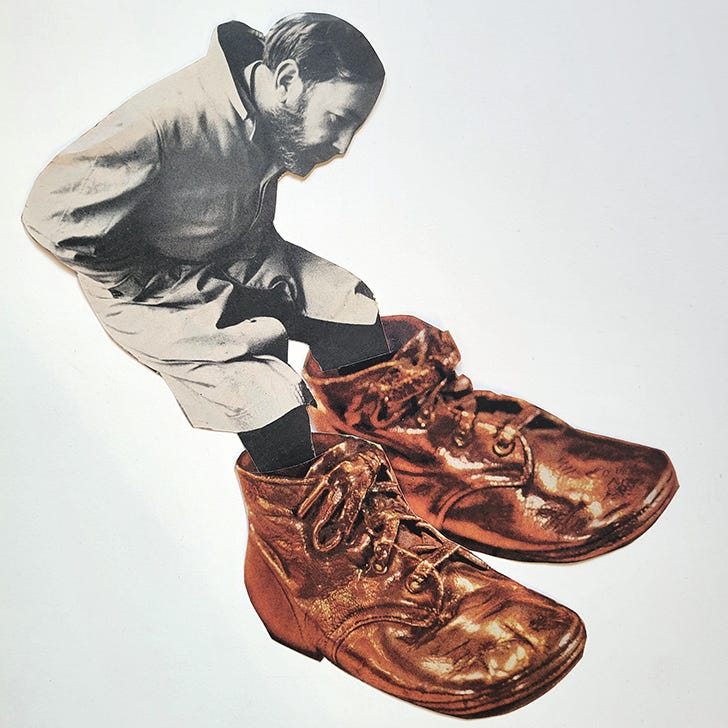
Or maybe there is an invisible hand that dictates archetypes, creating an illusion of synchronicity. The people I have known who work in advertising seem more attuned to this—the relentlessness of the zeitgeist—than most artists. The latter, haunted by genius, imagine themselves unique. The former—materialists by trade—know me that if you have an idea, execute it immediately. You can’t be the only one. (Fig. 7)
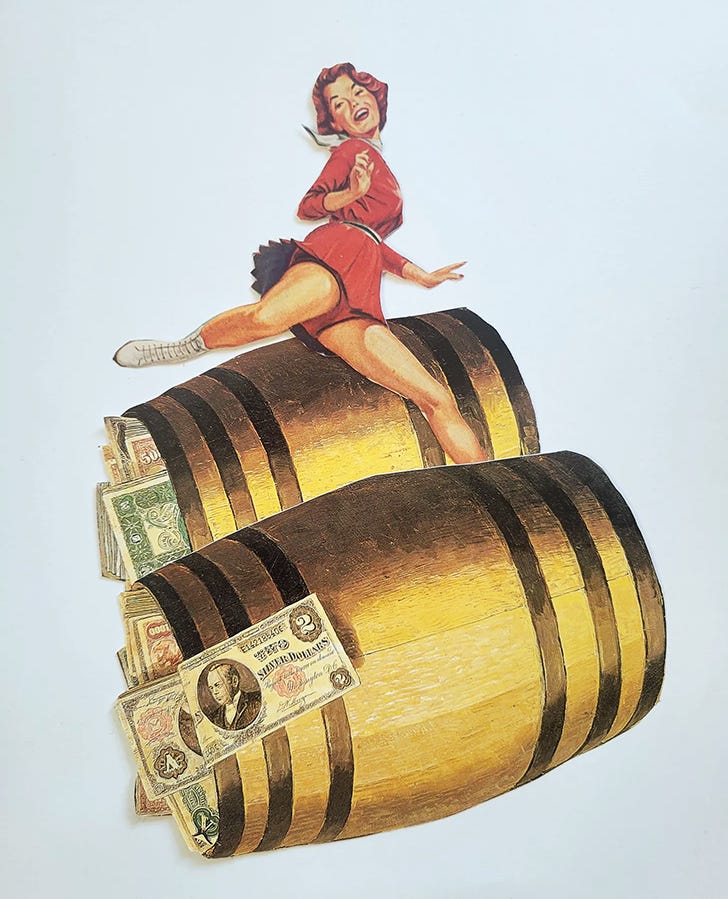
Or it could be that I’m suffering from apophenia, which has lately been invoked to explain our current conspiratorial imagination. Per Wikipedia, “apophenia is the tendency to perceive meaningful connections between unrelated things,” which strikes me as circular. Things become related, at least in part, by being connected in perception. If conspiracy is the unchecked, schizoid flow of apophenia, collage is its laboratory, bringing unrelated things in proximity to each other to experience how connections, meaningful or otherwise, arise. (Fig. 8)
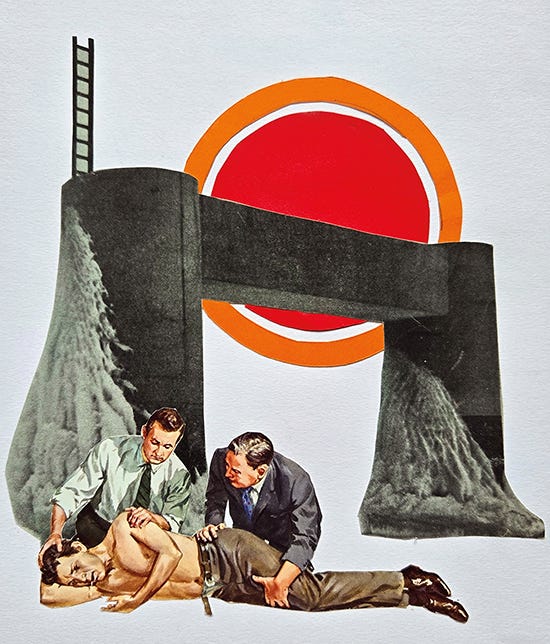
Such research makes creation—whether it’s writing or collaging—less reliable, but easier and more mysterious. A matter of conjuring rather than production. This becomes more appealing later in life, or it has for me, when one’s faith in sui generis creativity fades and you realize—having seen it all (or so it feels)—that you must collude with chance to surprise yourself, and failing even then. (Fig. 9)
Great to see this all in one place...