

René Daumal’s Sermon on the Mount
Grace after the death of God.

A wag on Substack recently noted that there are apparently only four ideas: the angel of history, the eternal return, will to power, and one I can’t remember, the idea being that all philosophical conversations on the Internet terminate in four commonplaces. (The fourth might have been the trolley problem.)
Philosophy might be understood as the articulation of all possible relations—universal/particular, whole/part, cause/effect—and while there are likely more than four, there may be fewer than we think. Look how exciting it is when a new one comes along. (At least until we discover it is an old one with a new name.) Kant’s phenomenal/noumenal was a game changer we’re still working through. Recent examples might include Lauren Berlant’s “cruel optimism” or Nassim Taleb’s “antifragility.” These are novel functions that can be defined, discussed, tested, and installed in new philosophical systems. I would love to read a catalog of every possible such component, though I’m sure some Hegelian would tell me it is called “the Logic” and maybe I should read it. To which, fair point.
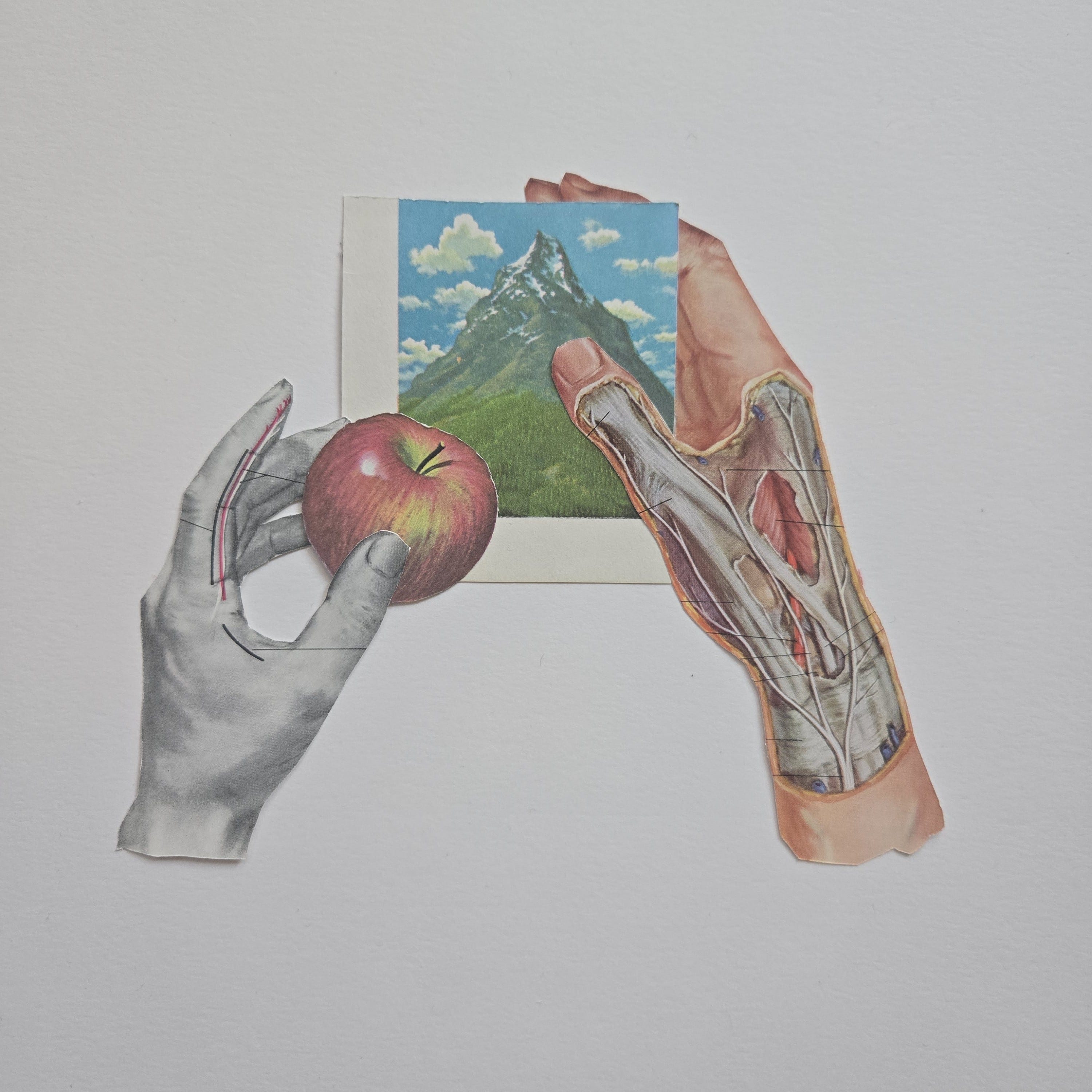
Mount Analogue, the unfinished, posthumously published novel by René Daumal—the somewhat unclassifiable French poet, pataphysician, and spiritual seeker—begins with a unique relationship that I’m not sure can be found elsewhere in fiction, philosophy, or myth.
As the novel begins, the narrator relates how he recently received a letter in response to an article he had written about “the symbolic significance of the mountain in ancient mythologies.” Therein he speculated that since all the mountains of myth, such as Olympus, have been explored and domesticated— become “what mountaineers call cow pastures”—only a new kind of mountain could serve to unite heaven and earth. A Mount Analogue. As he explains:
“For a mountain to play the role of Mount Analogue,” I concluded, “its summit must be inaccessible, but its base accessible to human beings as nature has made them. It must be unique and it must exist geographically. The gateway to the invisible must be visible.”
The narrator himself doesn’t seem to take this idea as more than a flourish in an otherwise “hasty survey,” so he is surprised when he receives a letter from a Father Sogol, who responds:
I have read your article on Mount Analogue. Until now I thought I was the only person convinced of its existence. Today there are two of us, tomorrow there will be ten, perhaps more, and we can launch the expedition.
From this remarkable beginning, the rest of the short, unfinished work details the expedition’s progress. And the beginning really is remarkable, steering a unique course between two familiar tropes. In a message in a bottle scenario, one party sends a message—which is presumably true and which the sender believes to be so—into the unknown, where against all odds it is discovered and understood. In a folie à deux, on the other hand, two people come to believe something that is absurd.
The Mount Analogue relationship is a blend of the two. A sender puts a message in a bottle that he does not believe to be true—or even possible—and it reaches someone who knows it to be both possible and real, which suddenly makes it real for the sender. It is a dialectical relation by way of Lewis Carroll.
Daumal spent his entire thirty-six years of life becoming the person who could invent such a novel relationship. A devotee of Alfred Jarry and all things pataphysical, Daumal founded a deviationist (according to André Breton) surrealist magazine called Le Grand Jeu (“The Grand Game”) when he was twenty and experimented with carbon tetrachloride in his youthful efforts to escape reason. Ultimately, he became a serious scholar of world religions—Hinduism, in particular—and a devotee of the spiritual teachings of George Gurdjieff via the latter’s pupil Alexander de Salzmann. Gurdjieff, who today would be described as New Age and be at risk for a Netflix exposé, was a charismatic figure who taught an idiosyncratic blend of non-dualist perennialism, my favorite detail of which is that those who had not awoken spiritually were doomed to serve as food for the Moon. But Gurdjieff, thanks in large part to de Salzmann and his wife—the dance teacher Jeanne de Salzmann—was to be influential on later avant-garde artists, from André Gregory to Peter Brook, who made Gurdjieff’s autobiographical book Meetings with Remarkable Men into a movie.
As the familiar story goes, WWI produced a sense that “our best thinking got us here”—as they say in recovery circles—which triggered the explosion of modernist attempts to get under, over, before, or beyond thought. Daumal serves as a sort of switching station because he thoroughly investigated three forms of post-rational exit: absurdism, chemical derangement, and spirituality. Daumal is like a prism. Jarry-inspired negation goes in and splits into John Cage, Timothy Leary, and Ram Dass, which explains his enduring resonance. Patti Smith is a fan. Alejandro Jodorowsky made a famous but terrible adaptation of Mount Analogue, having missed the spiritual point entirely. And one can still find the sickly green Overlook Press edition of the book on the front tables at certain independent bookstores.
Mount Analogue is best read alongside Daumal’s previous novel, A Night of Serious Drinking, issued by Overlook with a different but equally sickly green cover. Drinking is a pataphysical romp in which the narrator is guided from a pre-rational underworld of inebriation and given a tour of the three departments of Fidgeters, Fabricators, and Clarificators, which roughly correspond to businessmen and politicians, artists (“Fabricators of useless articles”), and scientists and philosophers. These “escapees” think they have risen above their state of intoxication, but they are deluded. We travel from workshop to workshop—as in the illicit sojourns in Severance—and meet many people whose methods have become disconnected from their ground, and have therefore become absurd. We even meet the author of A Night of Serious Drinking himself, who is part “Pwatt” and part “Mnemographer”—part poet, part memoirist, both in their inauthentic forms. This character, Aham Egomet—a fusion of Sanskrit and Latin words for “I”—helpfully describes the plan and purpose of the book:
In the first part, I shall picture the nightmare of lost souls who seek ways of feeling a little more alive but who, for want of direction, are driven from pillar to post into drunkenness and are stupefied with draughts which do not slake their thirst. In part two, I shall describe everything that goes on here along with the phantasmal lives led by the Escapees; how easy it is to drink nothing and how the illusory drinks served up in delusory paradises make you forget everything, even the word thirst itself. In the third and final part, I shall hint at the existence of drinks that are both subtler and more real than those consumed below but which must be earned with the glow of your brow, the anguish of your heart, and the sweat of your limbs.
Mount Analogue is the story of this latter effort, which cannot be initiated by reason—those who have tried are the “escapees” catalogued in the second part of Drinking—but only by an absurd relation like the one described above. Grace, if you will, but after the death of God. Once the narrator connects with Father Sogol—“logos” backward if you have not yet noticed—things continue apace. An expedition of experts is assembled in an apartment accessible only via mountaineering, from which the participants exit via the window. (One is reminded of Monty Python’s “Kilimanjaro Expedition” sketch, though the Pythons’ absurdism is deflationary rather than revelatory, since the “two peaks” is a projection of double vision, not true insight.) They reach the base of Mount Analogue and even find the substance, peradam, that is “both subtler and more real than those consumed below but which must be earned with the glow of your brow, the anguish of your heart, and the sweat of your limbs.” An expedition to the summit is planned.
Daumal died of tuberculosis on May 21, 1944, the manuscript halted in mid-sentence. It ends with an account of how a small act, the killing of a rat, had caused a destabilization of the mountain:
The old rat I had killed fed chiefly on a species of wasp found abundantly in this place. But, especially at his age, a rock rat is not agile enough to catch wasps in flight; so he usually ate only the sick and the weak who dragged themselves on the ground and could barely fly. In this way he destroyed the wasps that carried defects or germs that, through heredity or contagion, would have spread dangerous illnesses in the colonies of these insects without his unconscious intervention. Once the rat was dead, these illnesses spread quickly, and by the following spring there were hardly any wasps left in the region. These wasps, gathering nectar from the flowers, ensured their pollination. Without them, a great many plants that played an important role in stabilizing the shifting earth,
There are notes and plans for the completion of the novel in the Overlook edition, and likely elsewhere, but I haven’t read them. How can a project that must begin in absurdity satisfactorily end according to plan? Rather, the contingency of Daumal’s death serves to complete the sublimity of the novel, its summit forever inaccessible.
(Author’s Note: This article originally appeared at 3 Quarks Daily, where I write a monthly column. )
Elsewhere in pataphysics …
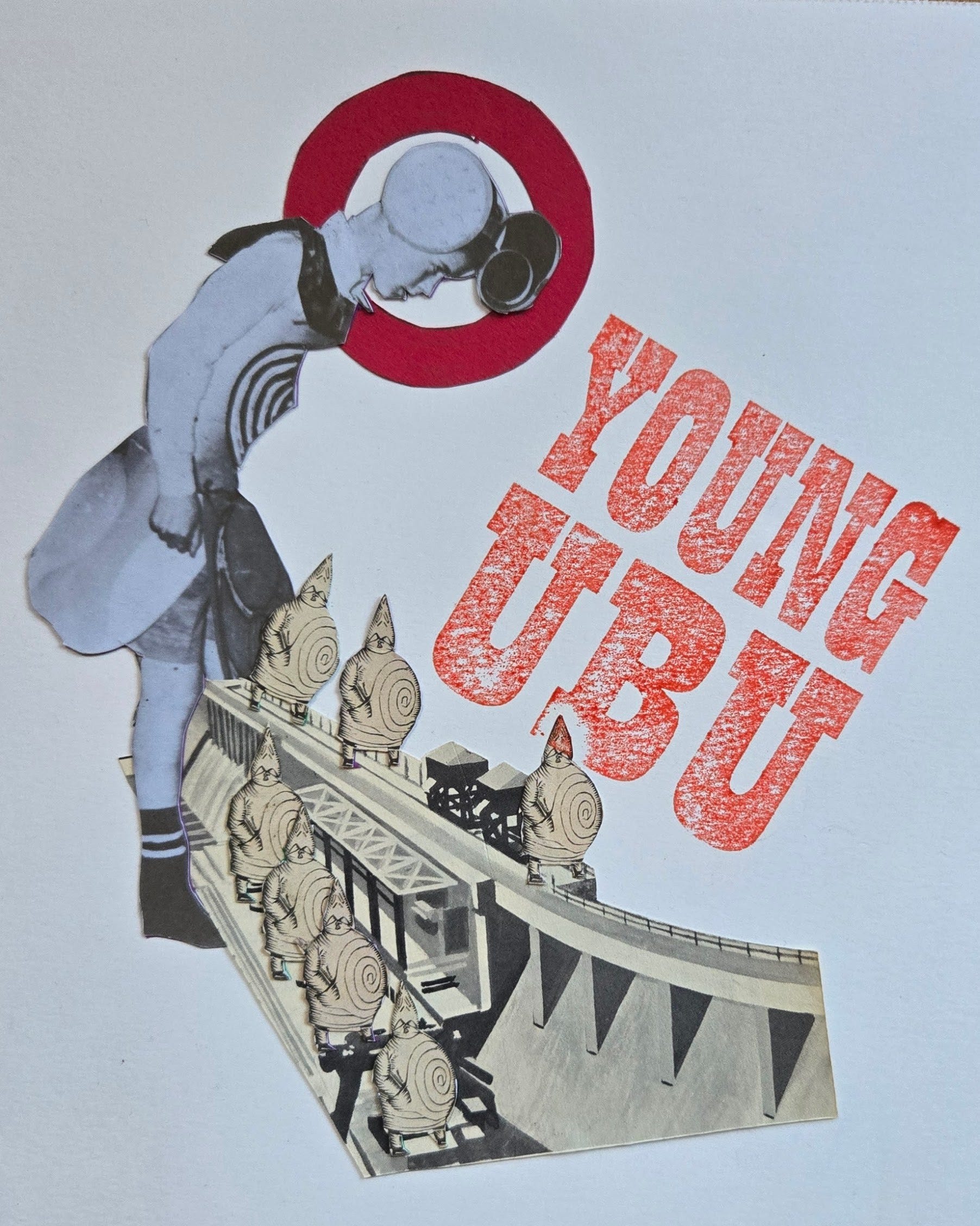
When Joe Meno at Allium, the lit journal at Columbia College Chicago, asked me to contribute to their “series of imaginary films by visionary writers” I knew the time to pitch the first installment in my ’pataTweens Animated Trilogy had come. I based the poster art for Young Ubu (above) on a previous collage that reminded me of Alfred Jarry’s monstrous creation, Pere Ubu. For those not familiar with Jarry, I think of him as the John the Baptist of Dada, about whom I will almost certainly have more to say in the future.
Thank you! A fascinating installment. I must read this book, assuming you have not dreamed it up entirely.
One part of your response — "A sender puts a message in a bottle that he does not believe to be true—or even possible—and it reaches someone who knows it to be both possible and real, which suddenly makes it real for the sender" — puts me in mind of Eco's "Foucault's Pendulum." I find that book a bit more difficult to enjoy now than I did when it came out, during my sophomore year in college, but I still love the conceit of cynical intellectuals who invent a playful conspiracy theory connecting every secret/occult society throughout history, only for real-life occultists to believe it's true. Daumal proleptically pushes that joke even further, it sounds like.
PS: YOUNG UBU is the best joke of the 21st century so far.
This was a brilliant discussion of Daumal, an author I'd never heard of but whose death is truly the best for a writer (well, minus the tuberculosis and young age... Basically just the dying mid-sentence). Incredibly, I'm reading Kiran Desai's The Inheritance of Loss and just two days ago fell down a rabbit hole reading about Mount Kailash/Kailasi in Tibet, sacred to Hindus, Buddhists, Jains, and Bons, "the ultimate spiritual center of the universe" (Wikipedia, if you can believe it). No one is allowed to climb it, but many people do the Kora, perambulating the 54 km around it. Not that this is equivalent to Mount Analague (great name that has a whole other vinyl meaning to it today), but just an interesting parallel in the "truth is stranger than the most absurd paraphysique you can come up with" vein. Will get the books, thank you!