

S2E3. Lou Reed's Nephew on Gatekeepers
“They are the only thing standing between us and the doxic heat death of the Internet."

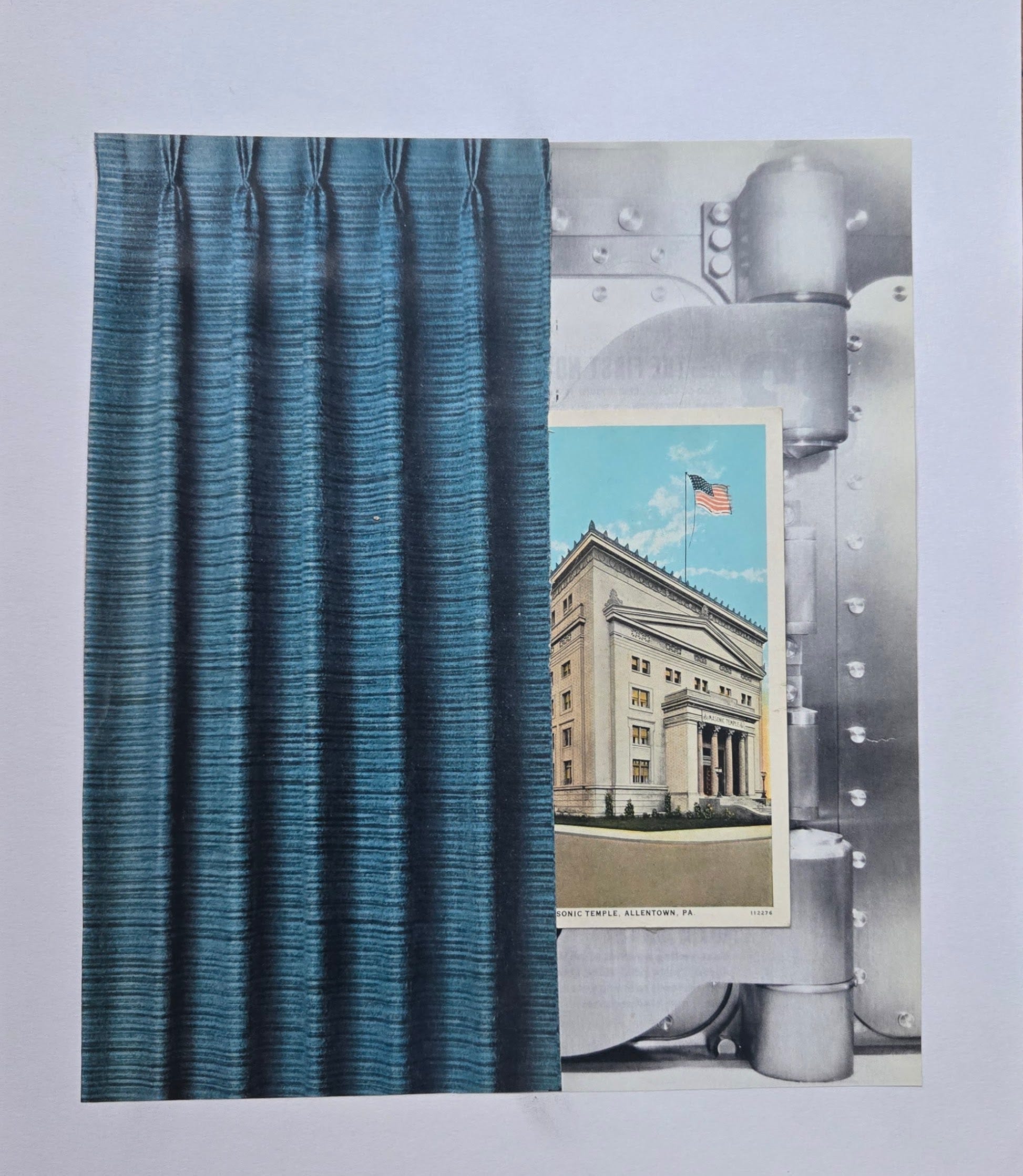
(Author’s note: I recently reconnected with an old acquaintance who will be familiar to longtime readers. If you are not familiar with our history, this is a good place to start.)
“Here we are,” I said. “Beyond the gatekeepers.”
I meant this innocently enough. Lou Reed’s Nephew was no longer employed by EasyOut—the outplacement service to which I was contractually entitled—and my entitlement period was coming to an end. I had gotten what I needed. A resume stuffed with keywords in human- and machine- readable versions. Like a handgun, I hoped I’d never have to use it.
I had returned to an idea I had been working on when I first met Lou Reed’s Nephew: the idea of cataloging places and events so people could find things to do. After all these years, people still needed things to do, yet it had become harder, not easier. There were just too many things. Instead of racing to put them all together—a race I had lost to companies like TrueEnough—there was now a race to take them apart, as the first of Lou Reed’s Nephew’s “four disagreements” predicted. (I still did not know the other three.)
I had recently launched a site that took them apart, focusing solely on “small” things to do. It got some traction, briefly landing on the homepage of Todos Today, complete with my kicky new LinkedIn photo. (The latter being part of the EasyOut tier to which I was entitled.) I was looking forward to talking to Lou Reed’s Nephew about it. I blurred my background this time, for parity.
“Here we are,” I said. “Beyond the gatekeepers.”
“Heaven help us,” he said. “Their work is so essential.”
I remembered how difficult it was to agree with Lou Reed’s Nephew. He resisted agreement at every turn.
“In what sense?” I asked.
“In the Newtonian sense, of course,” he said.
“You’ll have to explain.”
“Are you familiar with the second law of thermodynamics?”
“By reputation only,” I said.
“And Maxwell’s demon?”
“Educate me,” I said, thinking he might be referring to a Beatles song.
“The second law of thermodynamics states that the entropy—or disorder—of a system always increases over time, which is true, I believe, of opinions on the Internet.”
“I am lost.”
“Before the Internet, opinion sharing faced a lot of friction. There weren’t a lot of channels, and access to those channels was heavily gated. Opinions could not flow freely, so they became clumped into conventional wisdom and common sense.”
“I see.”
“But without such gating, the dynamics have changed. With effectively infinite bandwidth, the system no longer has to make choices. Every possible opinion can be expressed, and transmitted, with the result that every possible opinion eventually will be expressed held equally within the system, each individual having found the opinion that gives them the maximum clout relative to everyone else.”
“Influencer equilibrium.”
“Exactly,” he said. “Why do you think young men are constantly hurling themselves out the Overton Window? There is fresh land for clout farming out there. They are like the early colonists, itching for the bloody frontier.”
“I see.”
“Eventually the Internet will provide an equal amount of citations for every opinion on every possible topic and become completely useless as an information resource.”
“And what does this have to do with Maxwell’s silver hammer, or whatever?”
“Maxwell’s demon,” he said, exasperated. “Maxwell’s demon, in the classic thought experiment, is literally a gatekeeper. He stands by a frictionless door, deciding which particles to allow in to keep the system inside at a higher level of order. He is the bouncer at Club Entropy.”
“Okay.”
“And so these gatekeepers you despise …”
“I was just …”
Lou Reed’s Nephew held his hand up in front of his webcam.
“The gatekeepers that you hold in such contempt,” he continued, slowly. “They are the only thing standing between us and the doxic heat death of the Internet, ‘the night in which all cows are black,’ to quote Hegel taunting Schelling, or ‘grey goo,’ in the language of a previously unrealized tech apocalypse.”
“That is very grim,” I said.
“You’re the one who wanted to be free,” he said.