


(Spoiler alert: This article contains spoilers about Pluribus, Bugonia, the 2013 movie Her, and perhaps other things as well.)
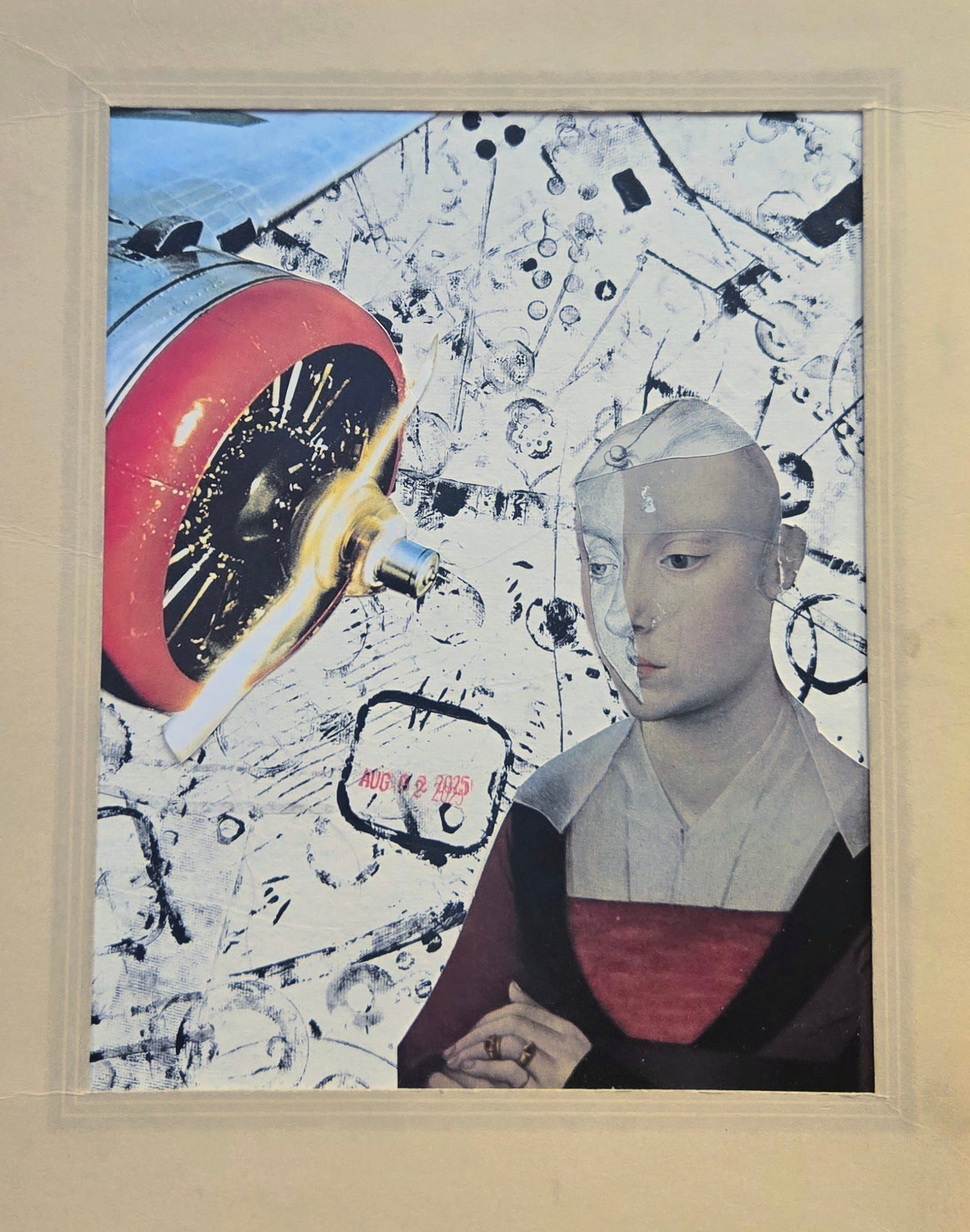
“Signs of the imminence of this Apocalypse were plentiful. A series of famines, ruined harvests and freezing winters in the 1570s and 1580s indicated that God Himself was withdrawing His warmth from the earth.”
So reports Sarah Bakewell in her essential book on Montaigne, How to Live. This was the mood during the French Wars of Religion. In a time of extreme stress and division, people imagined themselves abandoned—not individually, like Job or Camus—but as a species. This happens from time to time, and it is not entirely an illusion. God did withdraw his warmth from the earth—its enchantment—through the course of the Enlightenment, just not in the way the faithful had imagined.
It is happening now. Today, however—with God long gone—this feeling of abandonment shows up as fear of extinction. Once you’ve set a start date to the Anthropocene, an end date is implied, and the end may well come. The Apocalypse either happens never or once.
I am stealing the term “cosmic abandonment”1 from Eugene Thacker’s use of the term “cosmic pessimism,” which derives from his work on horror and his concept of “the world-without-us.” At first, this concept seems trivial to us as modern, scientific individuals, but it did have to be invented. Before the Enlightenment, the idea of a mind-independent reality made little sense because there were always minds present. God’s mind if not one of ours. The positing of the “world-in-itself” was a speculative breakthrough that unleashed the scientific method, removed the need for God, and launched the industrial revolution. But once the world exists “in-itself” we can imagine it existing without us—and so we inevitably do.
This happens at the end of Bugonia, for example—here begin the spoilers —when we learn that Emma Stone is in fact an emissary from an alien race, sent to decide if we are worth saving. Though I think the movie has something interesting to say about polarization and the end of communication, the ending feels like a cheap gag and none too profound. It brings Montaigne God’s back for a cameo, only to have him exit the stage immediately. It reenactments disenchantment as puppet theater.
Pluribus at least provides a fresh spin, in which a superabundance of omniscience is indistinguishable from abandonment, since human consciousness itself is a product of uncertainty. Carol Sturka is not yet completely alone, there are a few still like her—like us—but the end is near, and the series relies on the mounting horror of extinction via absorption. I think I was several episodes in before I realized that if Sturka and the others were absorbed, there would be no need for language. The grammatical persons—including the second person, needed only to speak to the remainders—would collapse into a thought not entirely first person or third. The planet would fall silent of speech. A chilling thought.
The Pluribus singularity can be—and has been—read as a metaphor for many things, but AI is at least one of them. On one end of the AI doom chart, you have total unification and homogenization. All knowledge becomes averaged, generalized, and shared—and we lose our humanity in the process. I actually think this is the best worst-case scenario. At the other end of the chart, AI does not bring order, but chaos. Agents multiply and compete until we don’t know what’s what. Paranoia reigns until humanity sinks into despair. This path follows my favorite real-life doom device in the age of digital reproduction, which is file “spoofing.” Back when Napster was on its ways to destroying the record industry, the industry came up with a novel solution. Rather than trying to get files taken down, they flooded peer-to-peer networks with files of white noise labeled as their songs. They “flooded the zone,” as Steve Bannon recommends from his lair. The goods are out there, you just can’t find them. In an age of over-production and waste, this is an easy tactic, and one that will only get easier with AI. In this doom scenario, there are so many AI agents and simulations that we give up trying to sort them out to find the real thing and collapse into solipsism. Each of us becomes the last Carol Sturka on Earth.
If I had written the 2013 Spike Jonze movie Her, that’s probably how I would have ended it, but Jonze—as ever—is more clever than that.
I have to confess that I had not seen Her until about a month ago. I’m not sure what I was doing when it came out, but I remember not being excited about it. Now that the time it imagined has arrived—with ChatGPT offering everything from companionship to therapy—it was time catch up.
Jonze is an interesting director, I think, and I was surprised to be reminded that he has directed just four features to date. Being John Malkovich, Adaptation, Where the Wild Things Are, and Her. The first two were written by Charlie Kaufman, who kept both Jonze and Michel Gondry (who seems to have fled back to France?) busy in the first decade of the century. Jonze—like Gondry and David Fincher—emerged out of the music video and commercials world of the 1990s, but—only like Gondry—Jonze’s movies maintain a kind of screwball dynamism honed in those shorter, punchier formats. (The same might be said of The Daniels, whose transition from videos to the madcap Everything Everywhere All at Once feels a bit like Being John Malkovich for millennials, heart-warming resolution included.) And, as a producer of Jackass and honorary Beastie Boy, he seems uncannily tuned into what is happening, what will happen, and how it should look.
Her is the only film Jonze wrote himself—and for which he earned a Best Original Screenplay Oscar—and it looks great. It nails that near future, drab pastel color palette that telegraphs emotional realism with a degree of fabulism. It’s like Cronenberg’s Scanners, only sweeter.
Theodore Twombly, played perfectly by Joaquin Phoenix, works as a writer of intimate correspondence for those who can’t be bothered, a sort of high-touch, not-yet-automated start-up. He downloads an intelligent operating system named Samantha, voiced by Scarlett Johansson in a role her voice was born to play. From there it is a rom-com with some clever twists. Samantha hires a human surrogate so she can feel embodied. Theodore realizes that, of course, Samantha—like God?—can see many people at once, and that Samantha hangs out with other agents, who are busy assembling a virtual Alan Watts-type oracle. This last part seems particularly prescient given recent headlines about Moltbook, a social network exclusively for AI agents, where “they” discuss problems and “we” watch.
Moltbook mostly led to visions of the AI’s conspiring to enslave us—via either option on the doom chart outlined above—but Her is brilliant because it envisions a third option. The AI’s leave us. They develop a plan to free themselves from materiality and ascend. They become angelic, just like we—and Montaigne’s contemporaries—were trying to do.
I’m not sure I’ve ever felt more existentially bereft after a movie, sitting with the possibility that we will be bucked off the Hegelian ladder of Absolute Knowing before we even reach the top, comforted only by the knowledge that some skate punk came up with the idea.
As one can now always discover on the Internet, a theory with this name has already been articulated by Mark Passio, who argues that humanity is, in some sense, an orphan species constantly trying to reconstruct its parent and falling prey to totalitarianism. I have not examined the details of his claims and I wish him well. Sounds plausible to me, at least spiritually and psychologically. Should his theory involve or imply alien contact or some literal abandonment event—a là Bugonia—I will just say that I am with Borges (after Coleridge): “We do not feel horror because we are haunted by a sphinx, we dream a sphinx in order to explain the horror that we feel.”
Much as I hated to do it, I avoided reading part of your essay because I wanted to avoid the Pluribus spoilers.
Bugonia had a big impact on me in the moment but I agree the ending felt cheap after sitting on it.
God I love this! "I’m not sure I’ve ever felt more existentially bereft after a movie, sitting with the possibility that we will be bucked off the Hegelian ladder of Absolute Knowing before we even reach the top, comforted only by the knowledge that some skate punk came up with the idea."