

How Many Books Is That?
Decoding Amazon's Best Seller Ranks.

Years ago, I helped the associate director at a cultural non-profit migrate the group’s mailing list from Outlook to an email service provider like Mailchimp. (It might actually have been Mailchimp.) We got it all set up, the first send went out, and she called me in a panic.
“Something is terribly wrong,” she said. “With this new system, only 35% of people are opening my email!”
I can’t say whether this is a hazard unique to liberal arts majors—which includes me, associate directors at cultural non-profits, and most authors, editors, and publishers—but we tend to be optimists. (At least when we are not catastrophizing.) In the absence of data, my client assumed that 100% of recipients were reading her emails. 35% was a total letdown, even though that’s a completely respectable open rate.
All this to say that I have yet to meet a would-be author—or even an experienced author from the literary side of the tracks—who doesn’t overestimate how many books are actually sold, by them and other people. (There are authors on the genre side of things who have a better idea.)
The question I get asked most often—now that I’ve explained what counts as a small press—is how Amazon Best Seller Rank (BSR) maps to actual unit sales. I think there is a sense in the literary world that this is an unanswerable question—one of life’s great mysteries—but it is not. Author Hugh Howey and “data guy” Paul Abbassi cracked this more than a decade ago where ebooks were concerned by having self-published authors share real sales so that ranks could be statistically mapped to unit sales. The same method can easily be applied to the print best seller ranks to find out how many copies a book has to sell in a week to make the top 50K, which is what Small Press Insights tracks daily. And the answer is around 45 copies per week across retailers. (This excludes specialty stores, libraries, and direct sales.) I’ve made some assumptions, but the estimate is conservative. It should be read as saying a print book ranked in the top 50K, 19 times out of 20, has sold at least 45 copies in the last week at retail. Here are the benchmarks for the rest of the BSR bands.
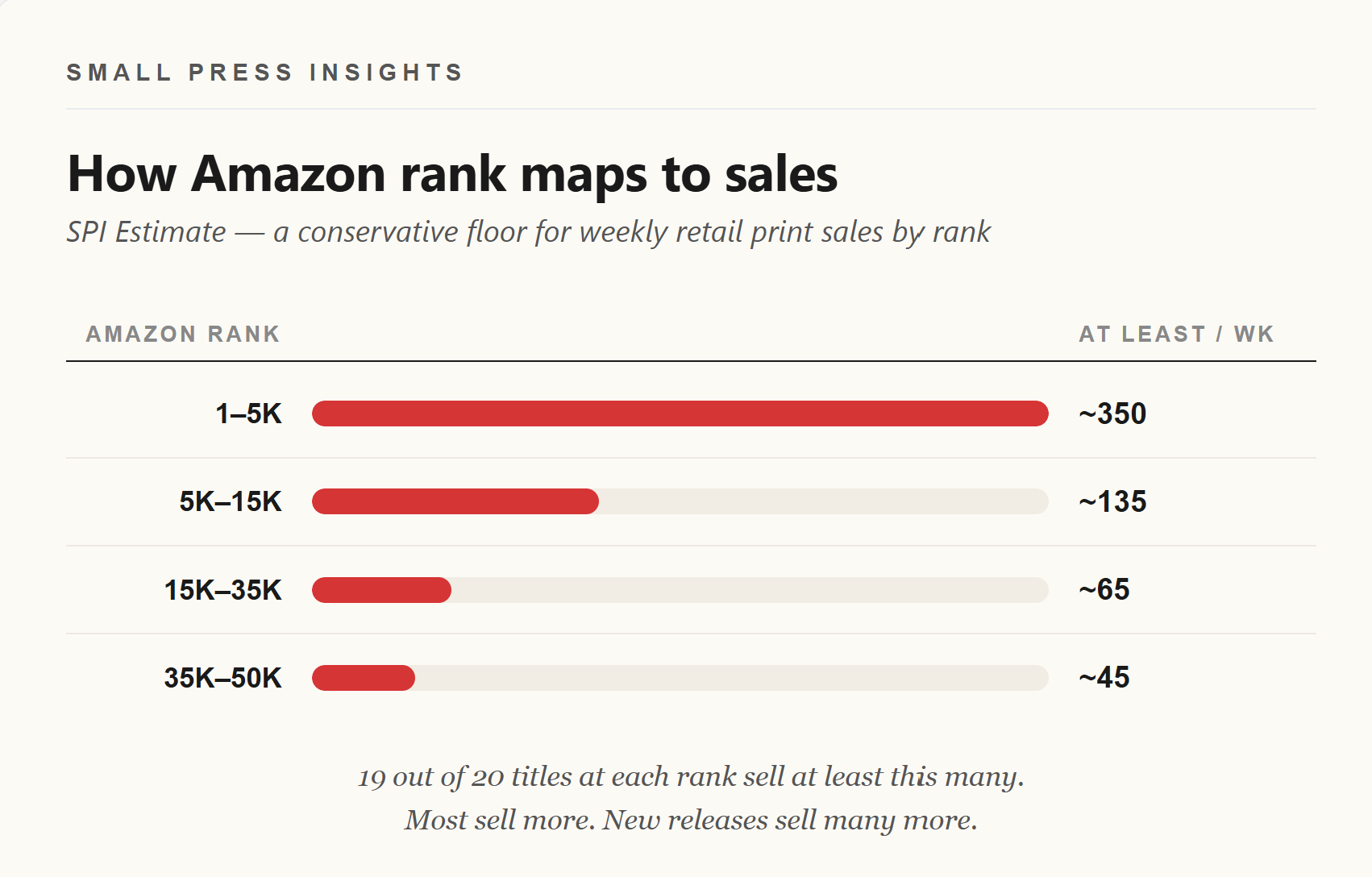
Obviously the top band has a volatile upper range. I’d guess that I Who Have Never Known Men—which is locked in around BSR rank #1,000—sells about 3,500 copies per week. Otherwise, these floors provide a benchmark for how much a book needs to sell to hit each of the bands. (Or how many you will need to print if you run a small press.)
Surprised? Disappointed? Encouraged?
There is a whole sub-genre on Substack featuring disillusioned writers revealing the awful truth that invidual book sales can be meager. I understand their frustration. I don’t think publishers are honest enough about sales expectations with authors, and perhaps not even with themselves. On the one hand, producing books—and culture generally—is a mysterious if essential human activity. French POWs during the Napoleonic Wars made intricate little boats with straw they pulled out of their mattresses. (I saw it on Antiques Roadshow UK.) We make stuff, and this spontaneity is infinitely valuable. So it can be hard, for everyone, to take a cold-eyed look at what happens when these makings hit the market. Most people cover their eyes at the point of collision, fearful that the ugly truth will destroy the mystery. Books Are Magic, after all. Fortunately, I don’t think this destruction is possible. As Lewis Hyde argues in The Gift, the mystery and the market are simply two different “economies.” The value of a work in one has nothing to do with its value in the other, and much anguish results from confusing the two.
That said, I think it is important for authors to have an accurate view of the market, should they decide to conduct business there.1 While disappointing at first, such realism is good for the art’s sustainability. It would have helped a friend of mine who, based on market dysmorphia, thought their debut novel was a flop, when in fact it sold quite well. (Would that their agent had told them this.) I think it might encourage small presses by demonstrating just how “in the game” they are. The bar is not that high, as you can see, but you first have to know where it is.
The above rank-to-sale legend now appears as a pop-up on SPI when you need it, and I will revise it as necessary.
You Heard It Here First
In my May column, I offered the following tip:
I’m calling it now: A Resistance History of the United States by Tad Stoermer from New Hampshire’s Steerforth Press, which comes out on June 2, will be huge at the indies.
How’d I do? The book debuted at #1 on the American Booksellers Association Nonfiction Paperback Bestsellers list, and at #7 on the New York Times’ Combined Nonfiction list. After its second week on sale, it sits at #2 on the ABA’s list and at #3 on the Independent Publishers Caucus list.
Do It Again!
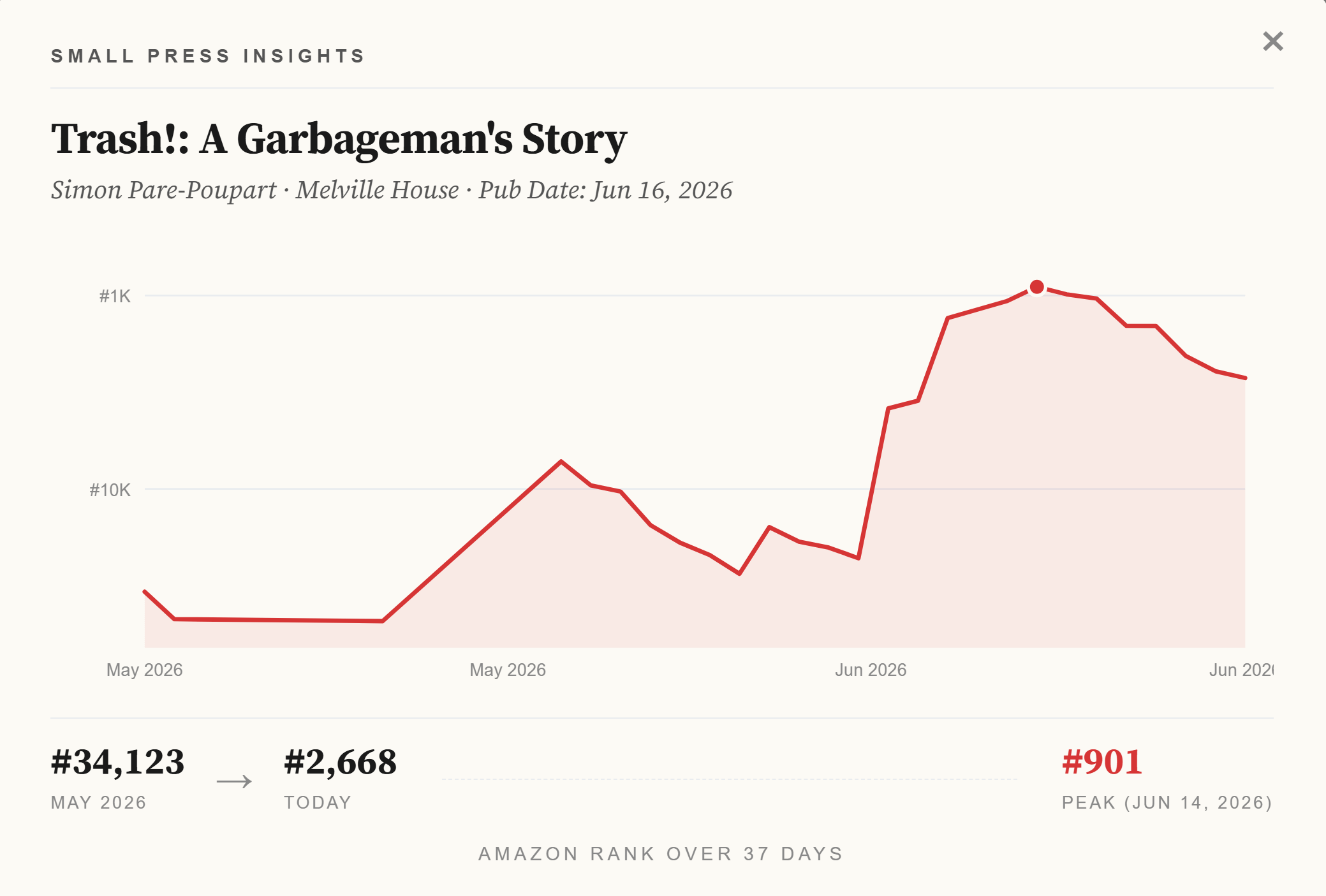
I have another pick this month, which is Trash!: A Garbageman’s Story from Melville House. Translated from the French, it is a memoir by Montreal trash collector Simon Paré-Poupart that has drawn comparisons to Anthony Bourdain. This went on sale last week and is eligible for this week’s lists—which drop tomorrow—so this might appear to be a bit of a lay-up. (Last month’s call was still a week from being on sale.) So I’ll raise the difficulty. I think Trash! will debut in the top 5 on the relevant ABA and IPC lists and in the #5-10 range on the Times’ Combined Nonfiction list. Be sure to subscribe to find out how I did.
Until then …
I don’t see anything setting up to be as big as Resistance History or Trash! between now and my next column on July 28—it is summer—but here are some releases I have my eye on, all of them ranking in the top 50K before their on-sale dates.
Too L.A.: Letters Never Sent (But Some Were) by Eve Babitz from NYRB goes on sale today.
The Veiled Prophet: Secret Societies, White Supremacy, and the Struggle for St. Louis by Devin Thomas O’Shea, out today from Haymarket, a narrative history at the intersection of racial politics and esoterica. (Like One Battle After Another, but for real.)
Hotel Exile: Paris in the Shadow of War by Jane Rogoyska arrives from Norton on July 7. Inter-war and post-war Paris viewed through the history of the Hotel Lutetia.
Some of my favorite artists chose not to and I think the allure of so-called “outsider” artists is they do not seem to be aware of the market economy at all, which—under materialism—represents the contemporary ideal of artistic detachment, the closest we can now get to Romantic genius. On the other hand, as a sculptor recently reminded me, agoraphobia literally means “fear of the marketplace.”
I bought Trash. My local indie bookstore had it in a pile by the cash among other small impulse purchase type books; might not have otherwise bought it. QC friends who read the French say it's incredible!