

What Counts as a Small Press?
My path to a necessarily unsatisfying answer, plus the small press insights of the month.

First of all, thanks for the positive feedback about Small Press Insights. I received warm responses from everyone I’d hoped to. Authors, booksellers, agents, and—of course—many small presses. It is clear that in a world where both the number of books and data-points-per-book are spiraling upward, thoughtful filters—like the one I set out to create to replicate the feeling of being at AWP or the Brooklyn Book Festival—have value.
The most common question I’ve been asked is “What counts as a small press?” and that’s what I’ve spent most of the last month thinking about. Before sharing the answer, I’d like to share my three principles for developing Small Press Insights, which are that it will be slow, thoughtful, and clear.
Why slow?
Well, I’ve done many things with crazed urgency before—as we all have, perhaps for most of our lives—and I’m curious to see what happens if (despite an increasing capacity for speed) I slow things way down. Books and writing aren’t going anywhere. (I promise.) We have a little bit of time.
My plan for the rest of the year is to develop the site and write about it monthly—on the fourth Tuesday of the month—sharing any changes, open questions, and my observations about small press publishing from the previous month. I see something exciting—something I could do or write about—almost every day, but I’ve restrained myself. (Mostly.) Without such restraint, you’ll notice, every platform—including Substack—quickly has every feature that every other platform has. Then someone has to go out and rebuild the thing that got the ball rolling in the first place. Since SPI is, at best, a para-professional endeavor—i.e. an inexpensive hobby with no clear business plan—I want to see if I can avoid overloading, and thereby capsizing, the canoe in the first place.
Slowness will help with thoughtfulness. With no rush to add features or address every contingency and constituency—chasing exceptions is the death of good products—the development can be thoughtful. I value elegance, in a technical sense, which turns out to be difficult to define. I take it to mean, for the purposes of SPI, creating the greatest opportunity for useful insight with the fewest number of rules.
Which leads to the third principle of clarity and the question of what counts, for the purposes of SPI, as a small press. Here is where it gets tricky. I don’t believe it is possible to draw a clear line between what counts as a small press and what does not. All I can do is make it as clear as possible how I am drawing a necessarily fuzzy line. This might sound trivial, but I can’t tell you how many taxonomy projects I’ve seen fall apart because the irreducible fuzziness of taxonomies wasn’t accepted by the participants beforehand. Then everyone leaves in a huff thinking the project failed because the other participants could not see the same clear lines, when such lines aren’t even possible.1 Knowing this, I chose “small press” as a way of dodging the taxonomy wars along the literary/commercial and indie/corporate axes. “Small press,” particularly after the demise of Small Press Distribution, was available.
So how did I draw my fuzzy line? I started with what was clearly in, using exhibitor lists from AWP and the Brooklyn Book Festival. Then I added presses listed in the directory of the Community of Literary Magazines & Presses (CLMP) and the members of the Independent Publishers Causus (IPC).2
At this point, I had dialed in on a segment that Jane Friedman, in her magisterial (and quite elegant) survey of the field calls “smaller presses,” wherein she flags its fuzziness as a segment, writing:
Unfortunately, the term “small press” means different things to different people. Here, it’s used to describe publishers that are traditional in practice, pay an advance (even if a small one), typically invest in a print run, and fully support their books.
So that’s the core neighborhood that SPI is meant to cover. (Wittgensteinian metaphors are hard to resist once you’ve leaned into the fuzziness.) From this emerged a few boundaries and revisions:
No Big 5. Because FSG is listed in the CLMP directory, the Macmillan imprint originally appeared on SPI and I liked that. I could watch how writers who had broken through via small presses like Madeline Cash (CLASH Books) and Ben Lerner (Coffee House Press) were doing, but it was also the question I got asked the most. In the end, I realized that ignoring the most celebrated distinction in the business (Big 5/not-Big 5) wasn’t sustainable.
No hybrid publishers. While I understand why the challenging economics of the business makes hybrid publishing (in which authors share costs upfront) attractive to publishers and some authors, I’ve decided to stay behind the curve on this. When I started going to AWP, it was to see what traditional publishing options I had, and I imagine a lot of users have the same interest.
No single-author publishers. For the same reason as above. I imagine that a lot of readers, particularly on Substack, are looking for publishers to publish their work, and such publishers aren’t going to do that. SPI did not launch with this rule and, as a happy result, I was introduced to the powerhouse success—on Amazon and at the indies—of Beth Brower’s The Unselected Journals of Emma M. Lion, which I think deserves everyone’s attention. I doubt it matches many people’s image of “literary” or “self-published”—its serialization, its packaging, its success at the indies—which is why it should be studied by anyone looking for a DIY path. Fortunately, this rule only means that Brower’s Rhysdon Press—and other single-author presses—won’t appear on the “Top Sellers at Amazon” and “Forthcoming Titles” tabs. They still appear via the “Top Sellers at the Indies” tab, which is a pass through of the IPC’s weekly “Independent Press Top 40 Bestsellers” lists with some aggregated historical data and Amazon ranks added for comparison.
So that is the core neighborhood. But neighborhood boundaries are unruly, as anyone who’s tried to rent an apartment in Brooklyn knows. So SPI is porous to two adjacent neighborhoods, the first being what Friedman calls University & Scholarly Traditional Publishers. Some of these came in via my original discovery mechanisms since they exhibit at AWP and, to a lesser extent, at the Brooklyn Book Festival. I think they are a vital part of the small press ecosystem, as presses and often as distributors. University presses are eligible to be included in SPI if they publish fiction, poetry, memoir, or general non-fiction intended for the trade. In some cases, I have applied a filter to capture that segment of a press’s program and exclude things like technical manuals. The filter is pretty broad and based on a little hand-written sign that used to be pinned (and may still be pinned) to several shelves at Spoonbill & Sugartown Books in Williamsburg. It indicated the section was for “Thought.” It included everything from Gladwell to Gramsci and saved me the time of figuring out whether what I was looking for would be in Philosophy or Social Science or New Age, because I—and therefore SPI—am into all of that.
On the other end are what Friedman calls Mid-Size Traditional Publishers. Her examples are W.W. Norton, Scholastic, Kensington, Arcadia, Chronicle, and Amazon Publishing. These are mostly out by category with a few exceptions. Norton’s Liveright imprint is in, since it explicitly serves this segment, and the rest of Norton is in with the same “thought” filter from above. Norton is large but employee-owned and they publish a lot of books that SPI would feel incomplete without. I have also included Bloomsbury Academic—my preference would always be to include an imprint in its entirely rather than apply a filter—because they table at the relevant conferences and the imprint includes several obviously relevant lines like 33 1/3 and Object Lessons.
I did get one question about Scholastic. By my lights, it is a mid-size publisher out by category, because—and I can’t stress this enough—Small Press Insights has a strict NO CHILDREN’S BOOKS policy. This is because I am not a child, don’t have children, and am not particularly interested in children’s thoughts or concerns. I mean, children are great, just not for me, and—at the end of the day—SPI is best understood as an editorial data product, just like the NYT Best Sellers list!
Finally, I have heard from people noting that SPI seems only to include the larger end of the small press world, which is true but solvable. SPI currently has 1,092 publishers on its list of small presses, but only 207 (~20%) have appeared to date in the top 50K print books at Amazon. To make the top 50K a book probably has to be selling around 100 print units a week. To capture more small press activity, I will need to go deeper into the Amazon rankings, which is a merely budgetary constraint.3 To go from tracking the top 50K to the top 250K—a 5X increase—will cost a few hundred dollars per month, and I’m thinking of ways to get there. The most elegant way would be to fund it with Bookshop affiliate fees, so—if you’re a fan—consider buying a book or two via the links on the site.
Alright. That’s what counts as a small press. On to the insights.
The Booker Bounce
The fun thing about having a dataset, once you’ve put it together, is that you can answer questions you didn’t yet have when you built it. In recent weeks it’s been interesting to watch what the International Booker Prize can do for small press sales, as seen through Amazon rank. Here is a chart showing Amazon rank for all six short-listed titles throughout the prize cycle.
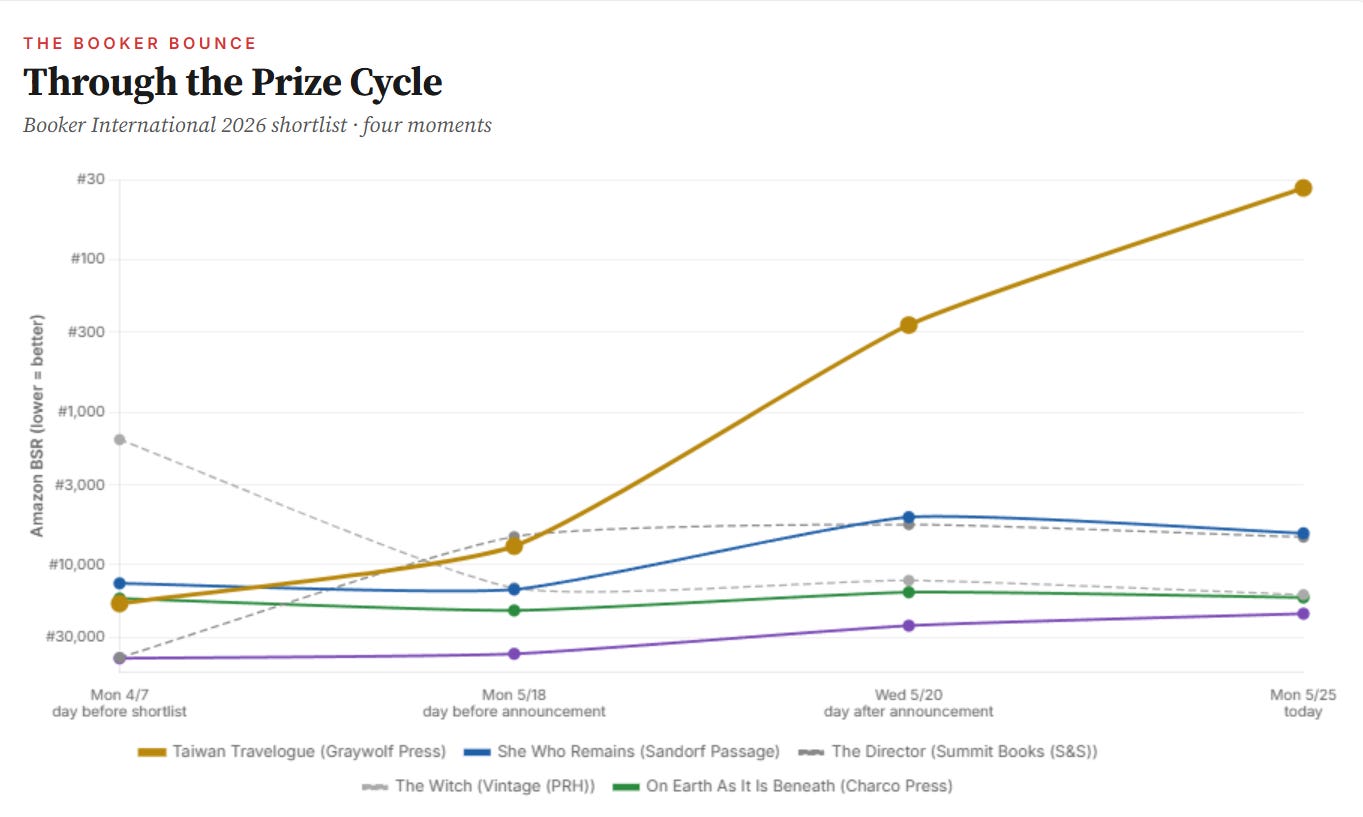
Small presses are shown in color. The two Big 5 finalists are shown in gray. All the titles benefited from the cycle, except for The Witch, from Vintage. This makes sense if PRH had already done a good job of getting word out about the book. In other words, it’s possible that awards are more valuable to smaller presses—as earned media—because they have less to spend on publicity and paid marketing.
The big winner here is of course Graywolf’s Taiwan Travelogue, which should provide the press with a financial shot in the arm. The book won the National Book Award for Translated Literature almost eighteen months ago, but the Booker nomination and subsequent win have propelled it into the top 50 at Amazon, its highest rank to date. It’s the second highest ranked title on SPI as of this writing, behind only Kathryn Stockett’s The Calamity Club from Spiegel & Grau. It has likely sold more than 10K copies in the last week, and it will be interesting to see where it settles. Here is another look at the impact on the short-listed titles.
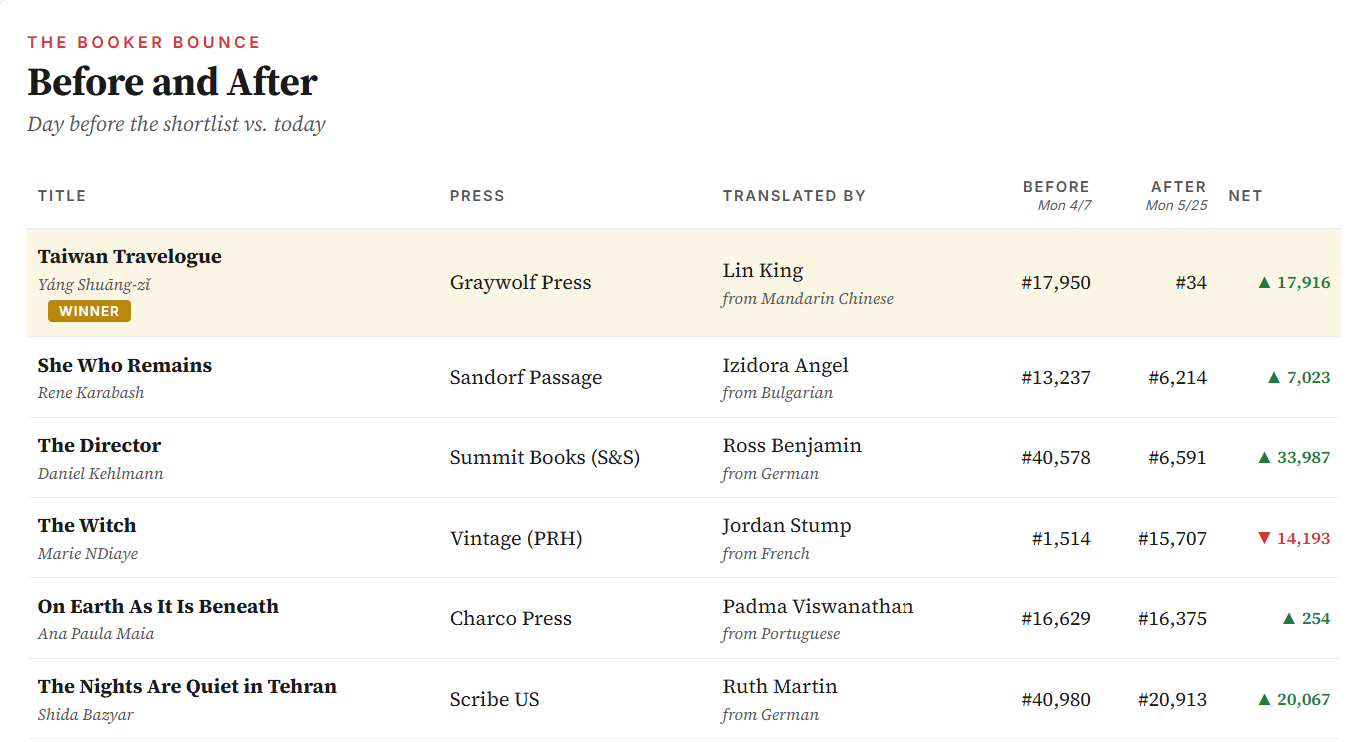
The other small press title to settle in ahead of the Big 5 entrants is She Who Remains from Maine-based Sandorf Passage. The story of a woman who becomes a “sworn virgin” to live as a man in a traditional Albanian village is written in an episodic, stream of consciousness-style and has a dystopian feel that invites comparisons to I Who Have Never Known Men (Transit) or The Wall (New Directions).
Just back from London, Sandorf Passage publisher and co-founder Buzz Poole talked to me yesterday as he was juggling keeping the book in stock without over-printing. “I know that the conversation around She Who Remains is only just beginning,” he said. “It came out here on January 27 of this year, so it's not even six months in the market yet.” And, unlike Taiwan Travelogue, it still has National Book Award cycle ahead of it.
The Big Miss: Mice 1961
Everyone was taken by surprise when Stacey Levine’s Mice 1961, from Portland’s Verse Chorus Press, turned up as a Pulitzer finalist, seemingly out of nowhere. (The Pulitzers don’t issue a shortlist ahead of time.) I was curious to see if Small Press Insights would have or could have spotted it, had it launched sometime in the past. The answers are “no” and “maybe,” though ideally I’d love to spot things like this in the future.
First, Verse Chorus Press was not on my list of small presses—it is now—so it wouldn’t have shown up whatever happened with the book. So that’s the “no.” If it had been on my list, what would it have looked like, as SPI now stands? The answer is in the chart below.
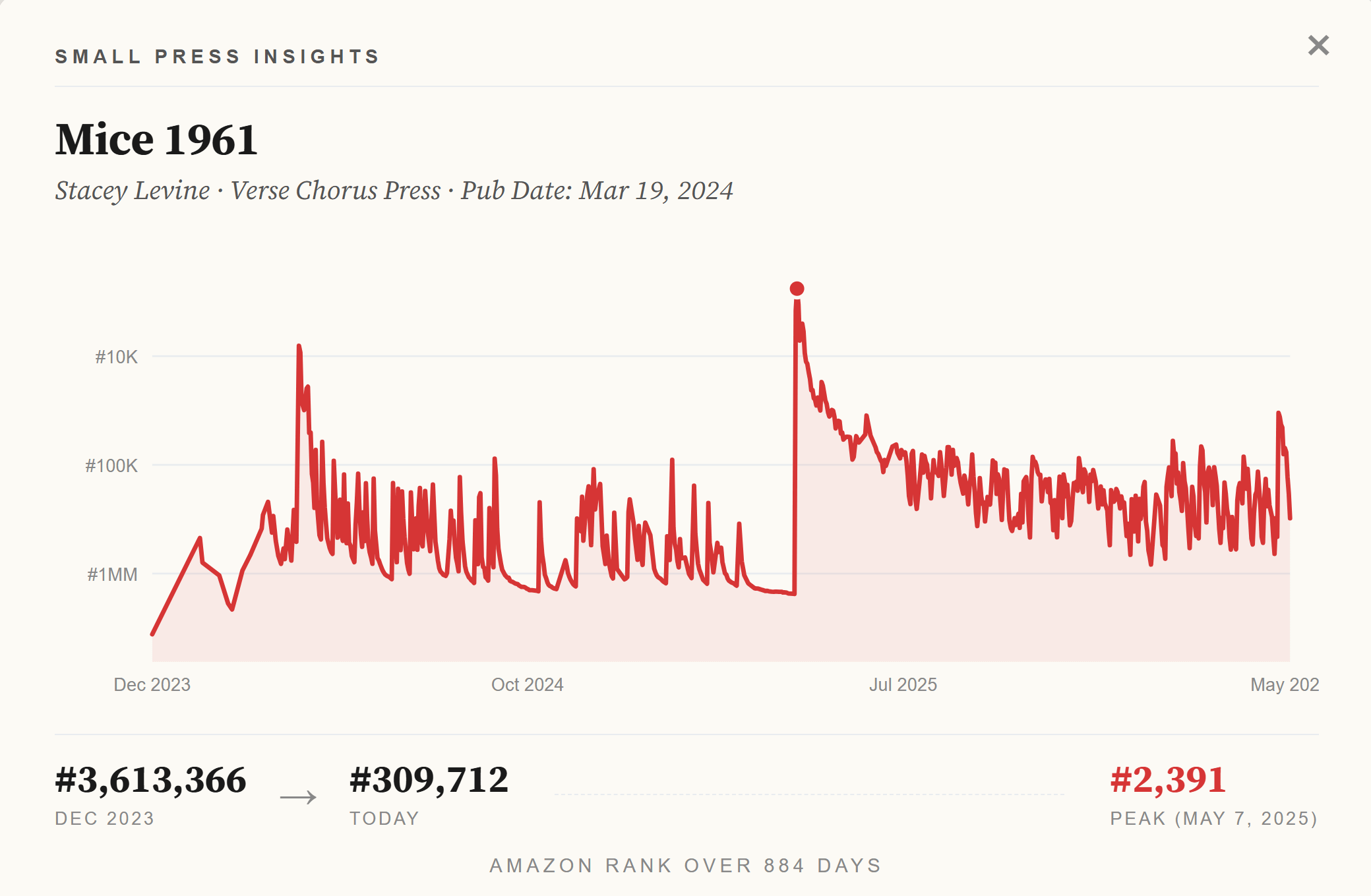
At publication, the book was in the top 50K—even the top 10K—so it would haven been visible for a bit before sliding out of the (current) tracking range. So it might have made it onto my radar? I’m not sure, but it would have been much more likely if I were tracking deeper into the rankings. The book was quickly snapped up and reissued by Ecco, a HarperCollins imprint, so will become now be invisible to SPI for a completely different reason, but—still—these “overnight successes” are what keep us going.
The Next Big Things
One feature I’ve added this month is a “Most Anticipated” tab on the front page. Its logic is incredibly simple. It shows small press books that are not yet on sale but are ranking in the top 50K at Amazon, which means they are showing strong pre-orders. Based on this, I’m calling it now: A Resistance History of the United States by Tad Stoermer from New Hampshire’s Steerforth Press, which comes out on June 2, will be huge at the indies. Stoermer is a public intellectual in the new mold—with large followings for his short form videos on TikTok, Instagram, and YouTube—and the book will appeal to people who already make Howard Zinn a perennial seller.
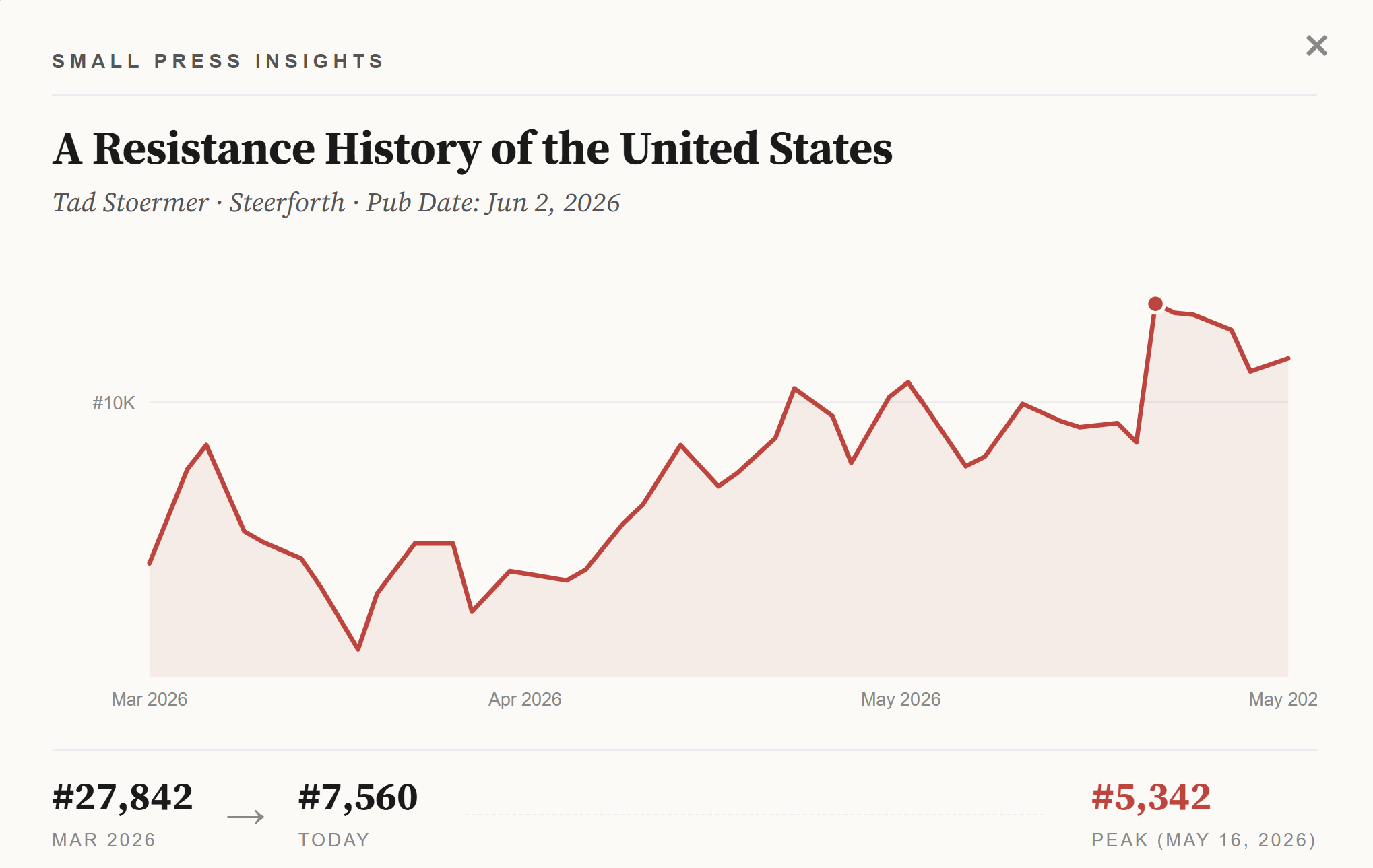
(Also note that the above is just a screenshot from the window that pops on SPI for every single title when you click on its line, so you can play along at home. It’s subtle. I didn’t want to put a big dumb button on every line, so it’s easy to miss. Give it a try.)
I’ll report back next month on how my prediction panned out.
One final tip. My contemporary Irish literature scout—my mother—loved Orla Mackey’s debut Mouthing after I procured a copy of the UK edition for her birthday. I just confirmed this AM that the rights failed to sell in the US, which seems like an opportunity for some small press or another, with a second novel coming, also set in the gossip-ridden town of Ballyrowan. She’s represented by Nicola Barr at Rye Literary in the UK.
If you want to know more about why and how I built Small Press Insights, listen to this episode of Conjuring Code, a new podcast about non-programmers building software with the help of AI.
One of the things that is so infuriating about online discourse is that it is naively pre-Wittgensteinian. (Late Wittgenstein, for sure, but maybe even early.) Everyone is trying to nail down necessary and sufficient conditions for this or that. If you find yourself in such a discussion, you should leave—and if you see one, you should resist the urge to enter into it.
As anyone who has worked with me, talked to me for more than ten minutes, or read this far will detect, I am a philosophy grad school drop out from way back and tend to apply a philosophical lens to concrete problems because, well, I find it interesting and helpful. In looking at the literary/commercial and indie/corporate axes, note that there are organizations that defend the interests of small publishers from the vantage of both content (“literary”) and production (“independent”). I don’t think this would have surprised someone like Hegel very much, since this is how he thought historical consciousness worked through problems: by trying one lop-sided attempt at a definition, then the other. It seems pretty clear to me that when “literary” became unsustainable as an elitist class construct, “indie” became the preferred mode of artistic self-justification, though neither quite works and works of lasting sublimity are to be found in every quadrant of the matrix formed by these two axes, as has always been the case.
I understand that some presses don’t sell via Amazon at all—which makes them somewhat invisible to my current methodology—but many of these books do show up in the Amazon rankings via Ingram or resellers.
I’m blown away by the amount of work you have done to compile these lists and indexes! I wish you’d been doing this back when I owned a bookstore (breathe books, 2004-2014). It would have been so helpful - even more so, I think, than Edelweiss or IndieNext or Indie Bound. Now that I’m an author, this also gives me insight on looking at publishers. Just fantastic! Thank you so much.
It's great to find somebody talking about small presses–and trying to bring some clarity for people. We don't qualify (yet), but I'm not in the slightest offended. I approve of the pragmatic approach.