

The Small Press View
Another way of looking at book publishing.

In 2022, when I was looking for a publisher for Lou Reed’s Nephew, my friend and sherpa Richard Nash suggested I go to AWP, the Association of Writers & Writing Programs’ annual conference. It was in Philadelphia that year. Richard is an old school publishing gadfly. He used to run Soft Skull Press and has turned out to be right about almost everything. He launched Red Lemonade, an imprint and online writing community, in 2011 on the premise that presses of the future would be part publisher, part a la carte MFA programs, offering classes and mentorship by established authors. Red Lemonade published new and backlist works by Lynne Tillman and others. Red Lemonade didn’t make it—too early being the same as too late—but it has been vindicated. Practically all presses support themselves with classes and access now. Chelsea Hodson’s business model is Red Lemonade, but right on time.
Richard knows what he’s talking about, in other words, and he suggested that AWP was the quickest way to take in the small press landscape all at once. Researching small presses online can be difficult. All of them say the same things, but mean different things. Everyone wants “new, weird, exciting, innovative work,” but they each have different things in mind.
In a 2022 interview, Olúfẹ́mi Táíwò told The Drift that analytic philosophy was “three book clubs in a trench coat,” but when it comes to publishing overall, the situation is much more grotesque. Book publishing is ten thousand book clubs, a million delusional neurotics (authors, myself included), various trends, fads, established and would-be religions, public and private institutions, thousands of small businesses, dozens of celebrity influencers, a few streaming services, five corporations, and an algorithm. In a trench coat.
In short, anyone who has a theory about publishing or says they like books has not yet provided enough information. Terms like “publishing” and “books” beg the question because they are not natural kinds but chaotic heaps. I feel the same whenever I go to Coney Island in the summer and see the exuberant diversity of city life. After that, when anyone says, “New York is …” I know they are about to utter a partial truth. New York—like book publishing—is many, many things.
All this can be cleared up with a day or two walking the floor of the AWP Book Fair—or the Brooklyn Book Festival, weather permitting—where you can see what publishers are up to by looking at covers, flipping through pages, and talking to people. I’m not interested in most of what is there, but what I’m interested in is there. I’m sure anyone would have the same experience even if their tastes differ from my own.
I’ve gone to AWP three of the last four years, but this year was the first time I went after more than ten years looking at the business not only as an author, but from inside a Big 5 publisher. Upon returning from Baltimore, I went through information withdrawal. Without access to proprietary (and expensive) tools like BookScan, I could no longer orient myself in the small press world. These books largely do not make the NYT Best Sellers lists—not anymore, anyway—so I only see anecdata about them on social media, Substack, and in places like Lit Hub, LARB, and The New York Review of Books. After more than a decade of having a 30,000-foot view, this wasn’t going to work. I needed the small press view.
This coincided with what, by most accounts, was a quantum leap in Claude Code. All my programmer friends were talking about it. You used to have to babysit it, they said, but after November it just did things. I know the topic of AI is fraught in the book world, so let me be clear. I am a writer. I do my own writing. I make collages out of paper I cut out of magazines. But what these tools can do with the tangles of data the book industry produces is pretty amazing. (Though babysitting is still, in fact, required.) A single subject matter expert can now build an entire data scraping, engineering, analysis, and visualization pipeline from scratch. So that’s what I did.
Small Press Insights, which I’m officially launching today, currently serves up three sets of data.
Small press print titles—from more than 900 presses, gleaned from the CLMP and the Independent Publishers Caucus—that appear in the top 50,000 at Amazon, refreshed daily.
The IPC’s weekly Independent Press Top 40 Bestsellers list, benchmarked against Amazon rank and with historical views—the list just launched at the beginning of the year—that show weeks-on-list and list appearances by publisher.
Forthcoming titles from all these presses, as gleaned from Edelweiss and Netgalley.
Looking at these, you can see a lot of interesting things. Here are a few of the things I see:
I was totally right to buy that Transit Books dad hat at the Brooklyn Book Festival a few years ago.
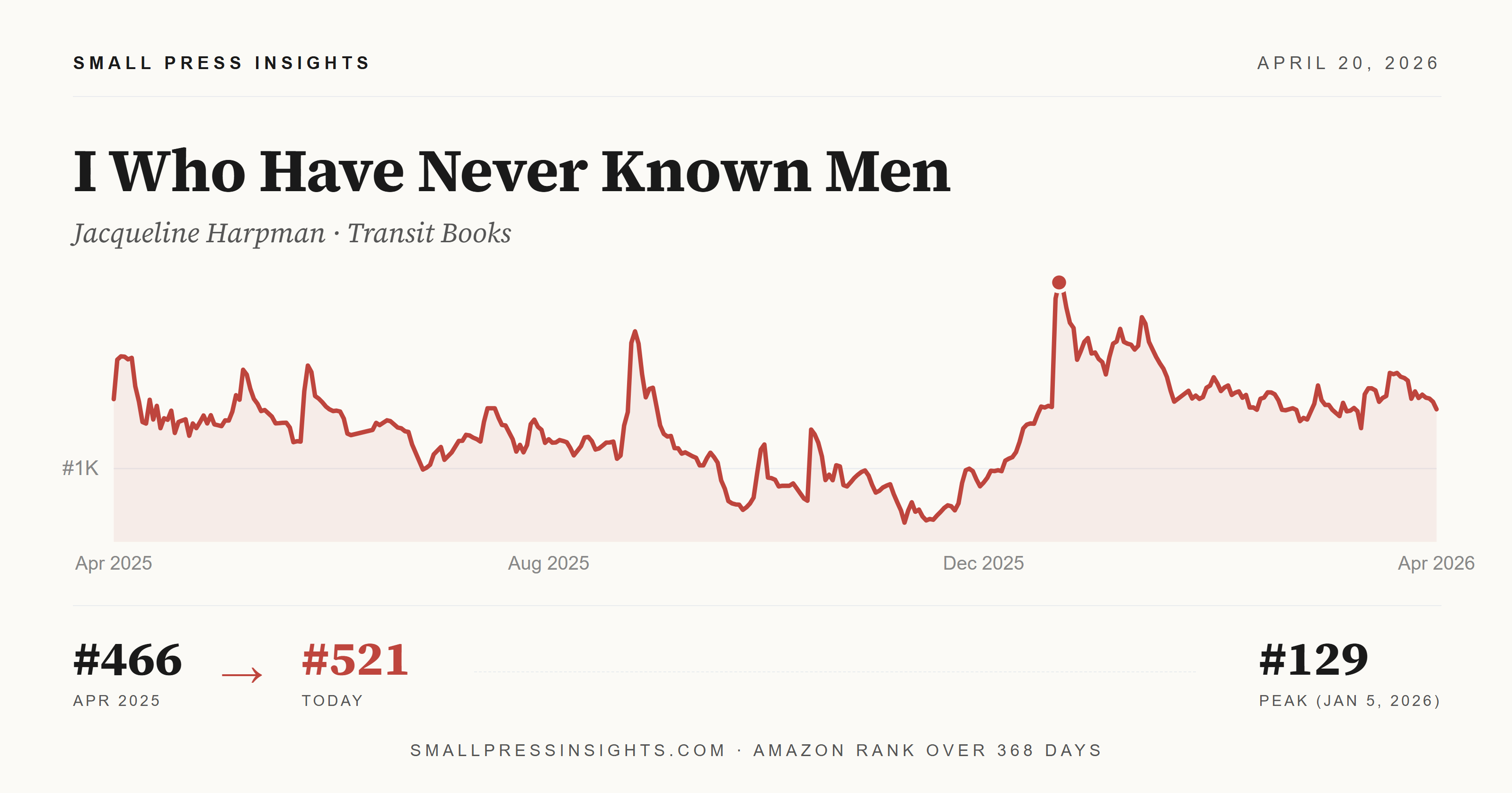
Transit’s 2022 US reissue of I Who Have Never Known Men—a translation of the 1995 dystopian novel by Belgian author Jacqueline Harpman—has to be the most fortuitous decision by a small press in recent memory. True, Transit had already found itself holding some of the Jon Fosse catalog when he won the Nobel Prize—husband and wife publishers Adam and Ashley Nelson Levy know what they are doing—but IWHNKM is next level. Having caught fire on TikTok, it is the third-highest-ranked fiction title on the list and has been selling at that level for more than a year. That’s a big deal that can set up a small press for growth and expansion. (Ben Lerner’s Transcription is already selling at a slower rate, two weeks after its release.) I’m interested to see what Transit does next. Last I checked, they were still focused on translations and some commissioned works in English, but they are well-positioned to do more.
Everyone talks about serialization, but Beth Brower did something about it.
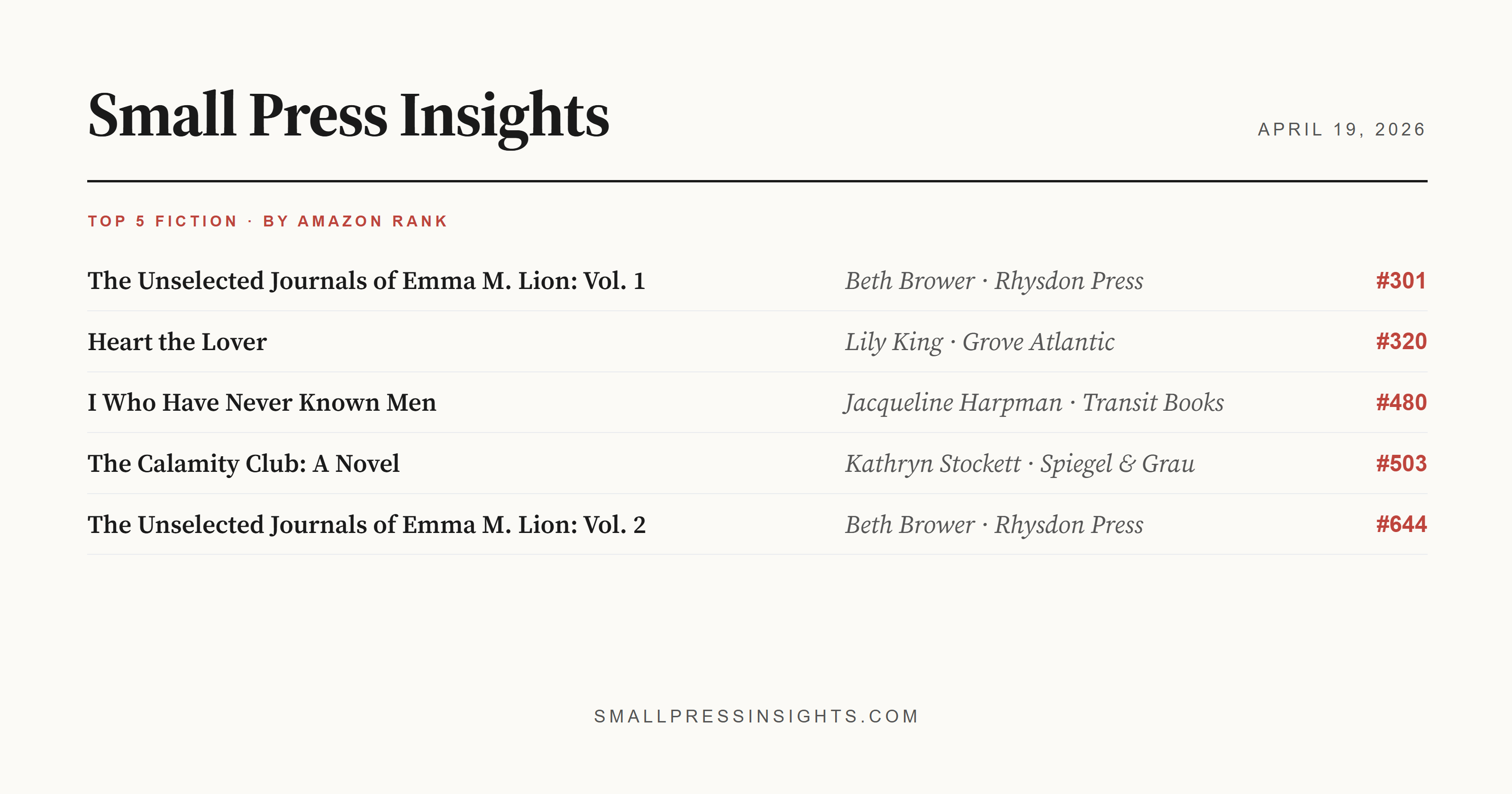
I had never even heard of The Unselected Journals of Emma M. Lion until I started this project, though obviously a lot of people have. Self-published by Beth Brower via her own Rhysdon Press, these journals tell the story, in detailed diaristic form, of a young woman’s adventures in 1883 London. One fan calls it “a combination of Gilmore Girls and Pride and Prejudice.” There are eight of these in print—two of them are in the top five in my fiction Amazon rankings and on the IPC bestseller list—with many more planned. Bloomsbury picked up the rights in the UK and I can’t help but wonder if there isn’t a giant US deal in the works. (If there is not, that’s a signal that traditional publishers have little to offer someone like Brower—who is already selling well in brick and mortar stores—though I suspect they will try a big bag of money.)
These aren’t really up my alley—though a quick listen reveals that the breezy writing is more precise than some more self-indulgent literary fiction I’ve read—but I like that Brower self-consciously thinks of her series in TV terms, the first five volumes representing Season 1. As a card-carrying post-modernist, this is something I can appreciate.
Good things happen to good work, and you can see it if you tune out the noise. (And mix sensory metaphors.)
Some people I have shown this to have expressed a sense of let down. Fewer than 1,000 titles in the top 50,000? Even Ben Lerner peaking at #181, with all that hype?
I understand. I would like to live in a world where a William Gass reissue cracks the top 100. That is not the world we live in, but did we ever? As Walker Percy said: “All serious writers and readers constitute less than one percent of the population. The other ninety-nine percent don’t give a damn. They watch Wonder Woman.” He said this in 1977. Eight years before Gal Gadot was born.
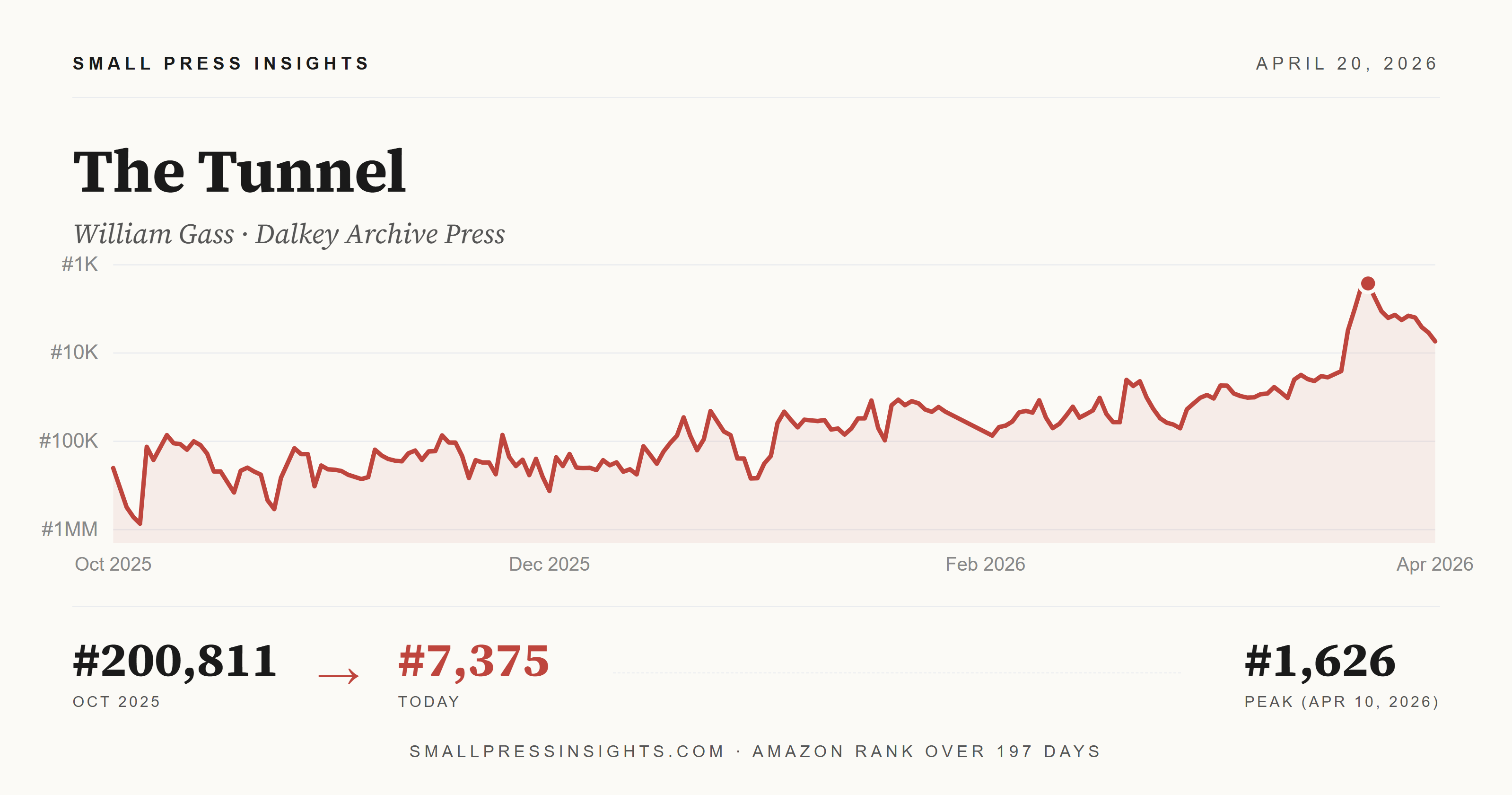
Looked at that way, the small press view is a bit brighter. 800 titles is actually 1.6% of the Amazon top 50,000, and—look—the William Gass reissue is going gangbusters! It even briefly crashed the Dalkey Archive website.
This year at AWP, I had a nice chat with Greg Wolfe, publisher of Slant Books. We had met before and I knew he published some books on art by Morgan Meis, who I know as a curator at 3 Quarks Daily, to which I contribute. Greg tipped me off to the fact that the trilogy was about to be written up in the New York Review of Books. It turned out to be quite a rave that declared Meis’s work “the most exciting new writing about the visual arts to appear in a generation.”
This propelled the first book, The Drunken Silenus—a fun, erudite read that seizes the Silenus myth from Nietzsche on behalf of Peter Paul Rubens—from sub-1MM obscurity to the top 15K at Amazon.
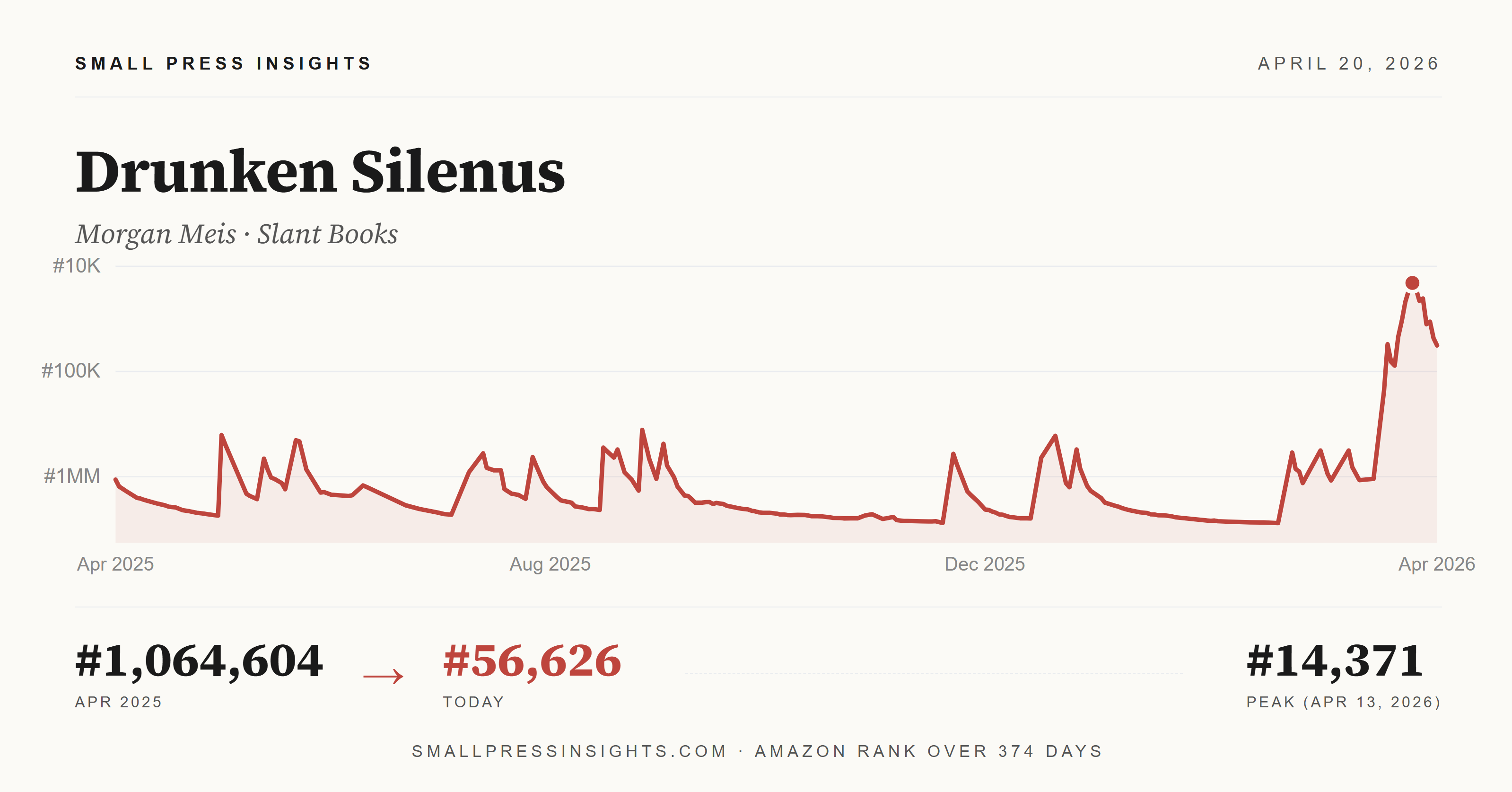
A chart like this makes my heart quicken, and I look forward to seeing what it will enable Meis and Wolfe to do next.
Limitations & Caveats
Needless to say, this is a work in progress. I have foregone labeling it a beta because life itself is a beta. That said, a few things to note. This tool can only surface books if they are a) ranking in the top 50K print books at Amazon and in the list of 900 “small presses” I have identified or b) appear on the IPC’s weekly Independent Press Top 40 Bestsellers list. “Small press” is doing some wiggle work for me here, but the list is more or less the union of the Council of Literary Magazines and Press directory and members of the Independent Publishers Caucus, or presses that have appeared on its bestseller lists. The presses on this list are either literary or independent, but sometimes not both. FSG is on the list—as is Algonquin—though both are part of the Big 5 (Macmillan and Hachette, respectively). When in doubt, I go back to my inspiration, which was the feeling of being at AWP or the Brooklyn Book Festival. That said, picking the list of presses requires some judgment, for which I take full responsibility.
Some small presses do not sell through Amazon at all—if they are distributed exclusively by Asterism, for example—and those books will not be visible here. Books that have not ranked in the top the 50K at Amazon will not show up either, though that is merely a budgetary constraint. I would like nothing better than to track all small press bestseller rankings on Amazon and will expand coverage as more budget becomes available. Right now, the best—and really only—way to help fund this project is to use the affiliate links to Bookshop.org to buy the books you discover here.
Who Will Find This Useful?
I have already found it useful for finding books I want to read. You might use it to build out your TBR list ahead of Independent Bookstore Day this Saturday. I can also imagine this being useful to authors, for seeing who publishes what and how well; to agents and editors, for identifying emerging presses and rising talent; and to booksellers, to shop for things to stock. And, of course, I’m sure it can fuel some good old gossip and speculation, both of which I enjoy.
What Will Happen Next?
The site is fully automated. Amazon ranks update daily, the Independent Press Top 40 Bestsellers list updates weekly on Thursdays, and forthcoming titles are updated twice per month. Bookmark Small Press Insights. Use it, share it, send me your feedback.
On the fourth Tuesday of every month, I will write about what I see in the data here on my Substack, so be sure to subscribe. It’s free.
The next update will be May 26.
Shout outs to 100% bootstrapped indie authors? I launched Her Mother’s Name completely on my own and cracked the top 5,000 in Amazon my first week! Currently at 22,000 but have a few upcoming promotions that should get me back in top 5,000 by end of month. The bottom line is if you write a book people want to read you can do all the marketing on your own and have similar success as a mid-level traditionally published author! There’s never been a better time to self publish.
This is brilliant! I love it when curious minds take it upon themselves to wrap their arms around complex information, particularly when it's spread across multiple sources, and make it much more navigable for the masses. Looking forward to following this project.