


(Author’s note: As mentioned earlier, I recently reconnected with an old acquaintance who might be of interest to longtime readers. If you are unfamiliar with our history, here is a good place to start.)
I heard his voice as soon as I stepped off the elevator, muffled only a little by the security door. I swiped my card, releasing the lock with a satisfying click, and swung open the enormous glass slab.
I was sorry to be running late. It had been explained to me that the weekly “Manic Monday” pep talks at EasyOut outplacement were the only things that cut through the miasma of the place.
My membership was a benefit of my mutual separation agreement from the advertising agency I had worked for as vice president of blah blah blah since selling my database of things to do True Enough LLC in 2013. Or it had been an ad agency when I started there. Since then it had described itself successively as a communications “practice,” a “networked neurodome,” a “thought-a-torium,” and—most recently—as “a free-range, no-kill influencer habitat,” which is when I realized it was time for me to go. “No-kill” made no sense in this context, as far as I knew.
I was not even sure that I wanted to be placed—maybe I had done enough to push my run-out-of-money-date out past my statistically-probable-death-date—but it was good to get outside. I signed up for a desk and dropped in a few days a week. That seemed to be all that was on offer, a familiar, office-like enclosure to go to while one processed—well or badly—one’s ultimate disposability.
I was ashamed about how good it felt, to get on the train and go to an office, even if the office itself had no purpose, although this did cast a troubling light on whatever sense the previous dozen years had made. They had made sense—and purpose—at the time, but EasyOut’s business model seemed to rest on the fact that this sense was remarkably easy to produce. A keycard, a receptionist, two walls, and wifi. When I travelled in Europe after college, I walked into medieval cathedrals and felt the presence of God, then remembered they had been designed with this feeling in mind.
Most of the other inhabitants, of which there we fewer than two dozen, were from finance and HR. (I assumed there were few tech people, despite layoffs, because they hated meetings, and this was just one big pointless meeting.) The finance types were tightly wound men in heated vests, pacing the the aisles, talking loudly on their phones. The HR people were mostly women, huddled in the conference rooms for salads, Diet Cokes, and mutual aid. The point of having a desk seemed to be to avoid it as much as possible. Everyone was over fifty.
The man who claimed the cube next to mine was an Albanian data scientist who had not so much been put out to pasture—I gathered—but exited due to chronic truth telling on topics ranging from the heritability of intelligence to American educational standards. He wore short sleeve dress shirts shot through with fine threads the color of wasabi. These seemed cheap but might have been expensive. His watch certainly was. Chest hair gushed from his collar.
“I do not do what Americans do in college,” he would say. “They do not read. They do not learn real math. What, what?”
One could answer or not. He didn’t seem to mind.
It was like the co-working space where I had worked on my database, but in reverse. One going up, one going down, both equal parts hope and fear. The EasyOut space had, in fact, gone through phases that mirrored my career’s. Scrappy innovation garage, overcapitalized co-working brand, and—now—humanitarian off-ramp. The Albanian called it “NoWork.”
The Albanian was in the front row in the conference room where Manic Monday was already in session. The splash zone. Usually an ambiguous display of naivete, fealty, and irony, but I knew he loved Manic Mondays. They provided a respite from the “nothings,” he said, which might have been a feeling or just what he called the rest of us.
I took the seat closest to the door. There were ten rows of chairs with an aisle in the middle—“classroom style,” in facilities lingo—with people positioned randomly between me and the Albanian, like matinee moviegoers, just less attentive. Most looked into their laps, scrolling for news that would deliver them from this purgatory as quickly as possible.
The second most surprising thing about Manic Mondays—after the Albanian’s rapt and sincere attention—was the presenter. The scene I have described would normally be completed by yet another dazed mediocrity at the front of the room, a laconic figure reading from a prepared script. But that was not this scene at all.
Instead the speaker appeared to be in a world of his own, and in this world he was presenting to dozens, if not hundreds, of serious and important people hanging on his every word.
“What is work?” he asked philosophically.
He scanned the room, as if someone might actually answer.
“Well, as physics tell us, work occurs when a force is applied to an object and moves it in space along a flat plane.”
He turned to the whiteboard and drew a crude diagram representing this, though it only seemed to serve as an anchor for his pointing and gesticulating.
“The unit for work is the joule, or the foot-pound. And does anyone know what the standard unit of capacity for work across time is?”
Silence. A brief glance at the Albanian, who was not quick enough.
“Right, horsepower. It’s horse power. But the point is, work is the result of force applied to an object.” He circled both force (and arrow) and object (a triangle) on his diagram. “And your goal, this week, should be to determine what your unique force and object are.” He stabbed the force and thing with his marker, proud of himself for having deduced our quotidian dilemma from the laws of the universe.
“What do you do? And what can you do it to,” he concluded. “That is your work.”
I experienced a strange sensation. I knew this man and partly recognized his features, but I could not place him. It was only the voice, the gestures, and the confidence that allowed me—after some effort—to overlay the person in front of me with the person I had known before. Of course. It was Lou Reed’s Nephew himself.
He had gained some weight, lost some hair, and his style had become oddly nostalgic and professorial. Matronly. He wore a threadbare tweed jacket and wide wale corduroys the color of sriracha.
After the session, I lingered a few steps from back the Albanian, who was getting all the time he could, explaining that of course he knew the answer was horsepower. When there was an opening, I stepped forward.
“Do you remember me?” I asked.
“Of course.”
“…”
“I’ve heard you’ve written a book about me.”
“Yes, I …”
“I hear it isn’t flattering.”
“Well, it’s a composite really and … It’s just a hobby.” I didn’t think of it as a hobby at all, but this is what I always said.
“I see,” he said.
I make it a rule to base all my characters on at least two people so I can pass a lie detector in the event of libel proceedings.
“And you’re not actually Lou Reed’s Nephew, anyway,” I reminded him. “Not literally. It’s a metaphor.”
“True,” he said. “When does this hobby of yours become flesh?”
“Next year.” I said. “Supposedly.”
“Well, good luck,” he said.
I almost left it at that. He didn’t seem interested in renewing our acquaintance. He’d started poking at his phone.
“But I’d love to catch up,” I said. “Hear what you’ve been up to.” I really did want to know. I had a hard time imagining it.
“You’re entitled to one one-on-one per month,” he said, “turning his phone around to reveal a QR code.”
I successfully scanned it after a few tries, then made sure it led someplace useful—it was his Calendly—and by time I looked up, he was gone.
L.R.N. Elsewhere
This month, you can also enjoy L.R.N. elsewhere online and in real life.
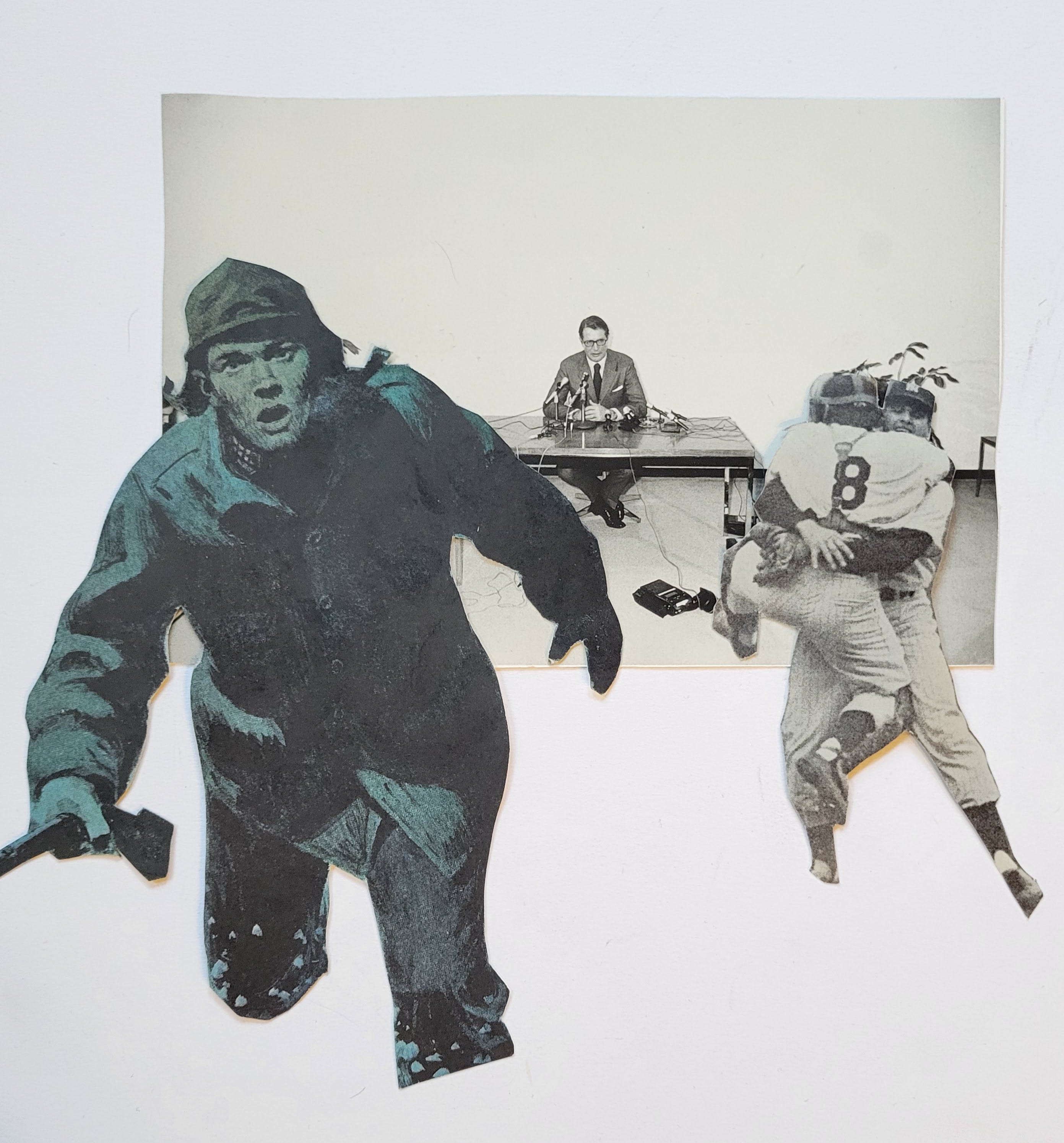
Over at HiLoBrow, para-academic ‘zine and blog pioneer Josh Glenn—of Hermenaut fame—is running a series of my collages, with my commentary, over the course of February. I’ve been wanting to write about how I started collaging and how it became intertwined with L.R.N. and my writing in general, so I’m telling that story there. Thanks to Josh for the opportunity.
Meanwhile this Friday, I’ll be reading at the launch party for issue 2 of The Panacea Review, which includes my antonymic translation of Wallace Steven’s “Parochial Theme.” Padgett Powell, who wrote The Interrogative Mood—a constrained writing classic—headlines.
I got a chill reading LRN say, “I’ve heard you’ve written a book about me.”
You know you're in trouble when Lou Reed's Nephew has basically the same job you do. And, even more bizarre, when I went to read this, it said 'Hardy' had recommended it to me...