

New Year, New Lou
"That’s right, I’m planning to 4X this thing!"

It’s been an interesting year here at L.R.N.
I took a break from the book publishing industry in the latter half of the year, which has given me more time to write. I’ve never benefitted from this historically, time to write—my writing time has always been stolen—but it’s gone to good use.
I sent you three essays and three amusements this year. To recall:
ESSAYS
“The Quiet Part,” an appreciation of Years and Years
“Trust in Hal Hartley,” a review of the director’s career and first film in ten years
“Generation Trouble,” an airing of grievances
AMUSEMENTS
“Liberal Aside,” an antonymic translation of Wallace Stevens’ “Parochial Theme”
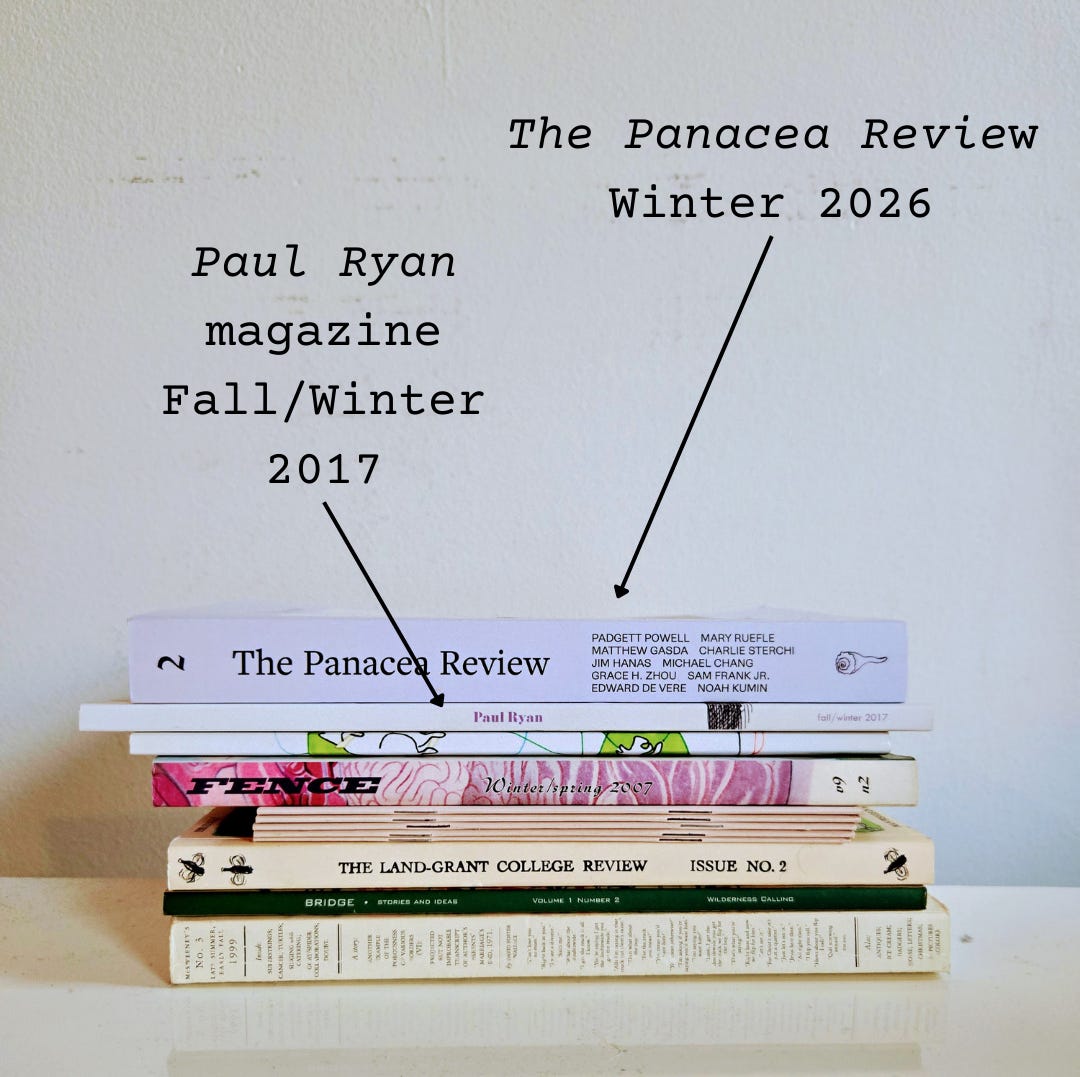
The second of the amusements, “Liberal Aside,” was republished in issue #2 of The Panacea Review, published in a place called Panacea, Florida, which sounds imaginary. When the issue arrived, I was delighted to find my contribution next to one from Padgett Powell, author of The Interrogative Mood, a novel written entirely in questions. A legendary piece of constrained writing. This is my first lit mag appearance—excluding a novel excerpt—since 2017, when I made a pseudonymous contribution to Paul Ryan magazine.
My CV is shaping up nicely. I think I might get tenure.
Working with Oulipo-type constraints was inspired by my casual engagement with The Writhing Society, a group in Brooklyn founded by the writers Tom La Farge and Wendy Walker. (Though they have not met in a while.) My short story from last year, “The Undepressed Person,” was an inversion of David Foster Wallace’s “The Depressed Person,” and “Born to Run Considered as an Annual Report” is the third in a sequence initiated by Alfred Jarry and J.G. Ballard.
This kind of play becomes more appealing later in life, I think, when one’s faith in sui generis creativity fades and you realize—having seen it all (or so it feels)—that you will have to collude with chance to surprise yourself.
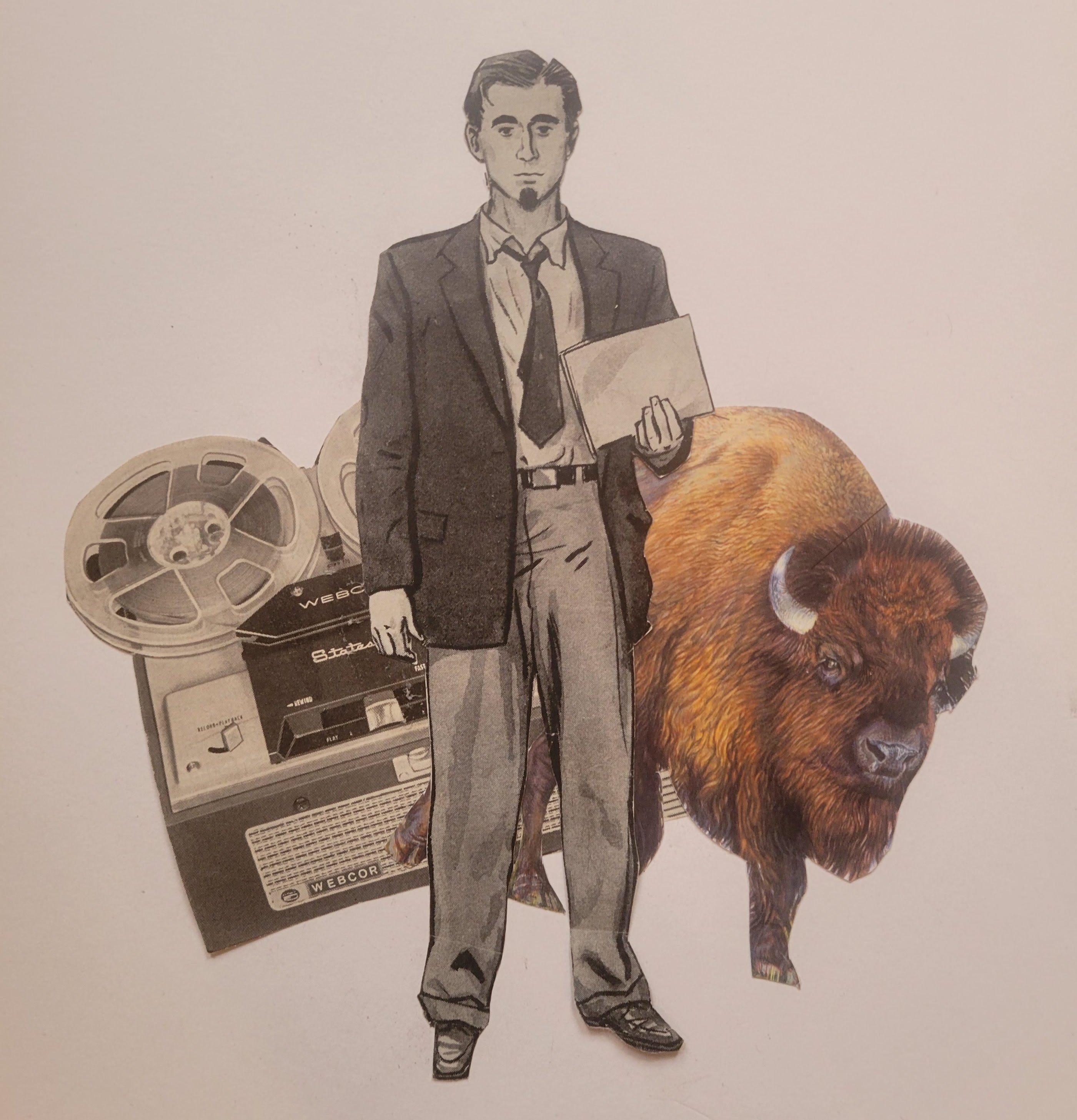
This is related, I think, to my late-breaking enthusiasm for collage, which emerged spontaneously in 2022, when my novel went out on submission and I was sick to death of words. I’m going to tell this story more fully next month at HiLoBrow, but collage—analog collage, specifically—is a fascinating way to eliminate possibilities and generate surprises. In the world of even twenty years ago—where you could adjust, color, or resize anything—it is a challenge and relief to find how these pieces go together, or can be made to seem to go together, as they are. Again, it is a way of colluding with the given to create the unexpected.
But the book? What about the book? As I wrote when Coffee House agreed to publish it, I was not all that concerned about when it would come out, since having a book coming out is the best possible state for a writer to be in. Well, circumstances are extending this blissful period even longer than expected! Fall '27 it looks like, sometime between September and December 2027, a bit less than two years from now. That’s the current publication date.
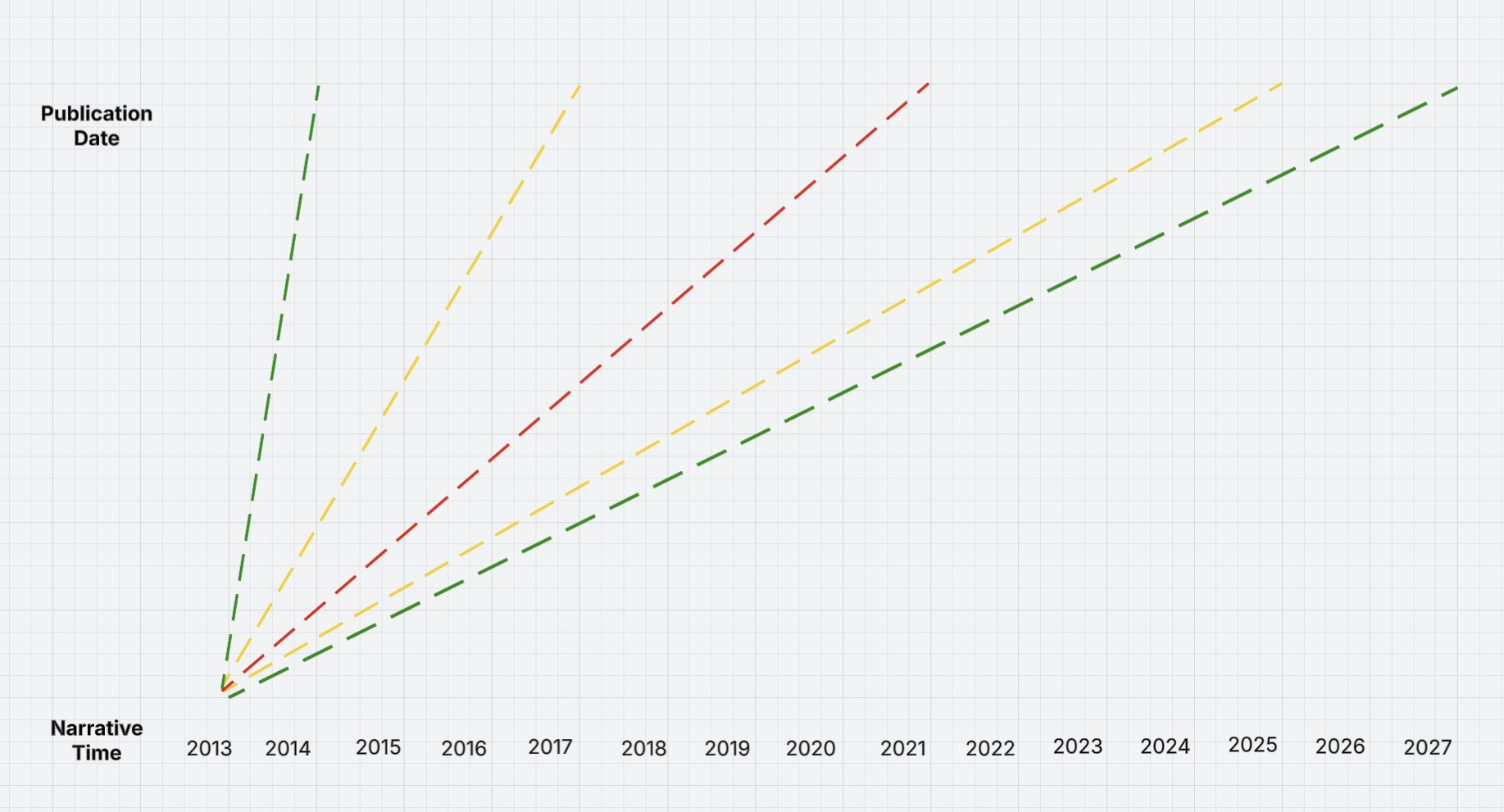
A young marketing consultant assures me that this is totally fine and, in fact, great, as there is a period of time after the events in a novel take place during which the dated elements do not yet seem charmingly screwball and off, but uncool and wrong. (“Cheugy” was the precise word used.) They seem like mistakes. The peak of that dangerous period occurred in 2021 (see chart below)—during L.R.N.’s corporately-prudent occultation—but was starting to lift during its serialization in 2023. By 2027, the details therein will seem clever and winning, like steampunk. Booker longlist here we come.
In the meantime, production here will ramp-up considerably in 2026. I published six pieces this year, and next year plan to publish twenty-four, two per month. That’s right, I’m planning to 4X this thing!
Once per month I am going to write an essay about something I’ve become enthusiastic about—topics currently in the workshop include René Daumal, Walker Percy, and Kurt Tucholsky—and then once a month I’ll share the details of an acquaintanceship I recently renewed, against all expectations. I think longtime readers will find it interesting. These types of posts will alternate alternate Tuesdays. So you’ll get something new from me every other Tuesday, starting today.
For that, I’m sure you’re thinking, how much can we pay you? What are the tiers? How do I become an apprentice, or a cuckold, or a mountaineer? While of course it is tempting to cash in and become a Substack dozenaire, I’m not looking to work for anyone at the moment. (Not even you, dear reader.)
But if you like what you read , please pass it along. And if this has been passed along to you, consider becoming a free subscriber. That’s what you can do to make me happy as I wait for that terrible day, still far off, when my book comes out and I have to start over again from nothing.
And there are prizes! Refer enough people and I’ll send you:
The ebook edition of my 2010 ECW Press/Joyland short story collection Why They Cried, which is currently out of print and available no other way.
A set of five collage postcards titled “Other than that Mrs. Rauschenberg, how was the show?”
A signed edition of Lou Reed’s Nephew, when it is eventually published, no matter how long that takes. I will not forget. I will find you.
Below are the details on how all that works.
Thanks for reading in 2025 and thanks in advance for reading and supporting L.R.N. in 2026.
How to win prizes for spreading the word:
1. Share Lou Reed’s Nephew. When you use the referral link below, or the “Share” button on any post, you’ll get credit for any new subscribers. Simply send the link in a text, email, or share it on social media with friends.
2. Earn benefits. When more friends use your referral link to subscribe, you’ll receive special benefits.
Get Why They Cried ebook for 3 referrals
Get L.R.N. postcard set for 10 referrals
Get signed copy of L.R.N. for 25 referrals
To learn more, check out Substack’s FAQ.
“This kind of play becomes more appealing later in life, I think, when one’s faith in sui generis creativity fades and you realize—having seen it all (or so it feels)—that you will have to collude with chance to surprise yourself.” Right. BTW do you follow Christopher Sorrentino’s substack Scarcely Human? He’s been exploring similar issues there.
https://christophersorrentino.substack.com
There's something deeply refreshing about a writer whose CV strategy is "weird, legal, and rare." The constrained writing, the analog collage as antidote to word-sickness, the cheerful indifference to publication timelines because "having a book coming out is the best possible state for a writer to be in." This is someone who's figured out how to actually enjoy the thing rather than just survive it.
Your point about needing to collude with chance to surprise yourself later in life rings true. The faith in sui generis creativity is mostly a young person's game. The rest of us need rules and limitations to get somewhere we didn't expect :)
Looking forward to the 4X era.