

S2E2. Lou Reed's Nephew and "The Four Disagreements"
Wherein we learn that L.R.N. is writing a book of his own.

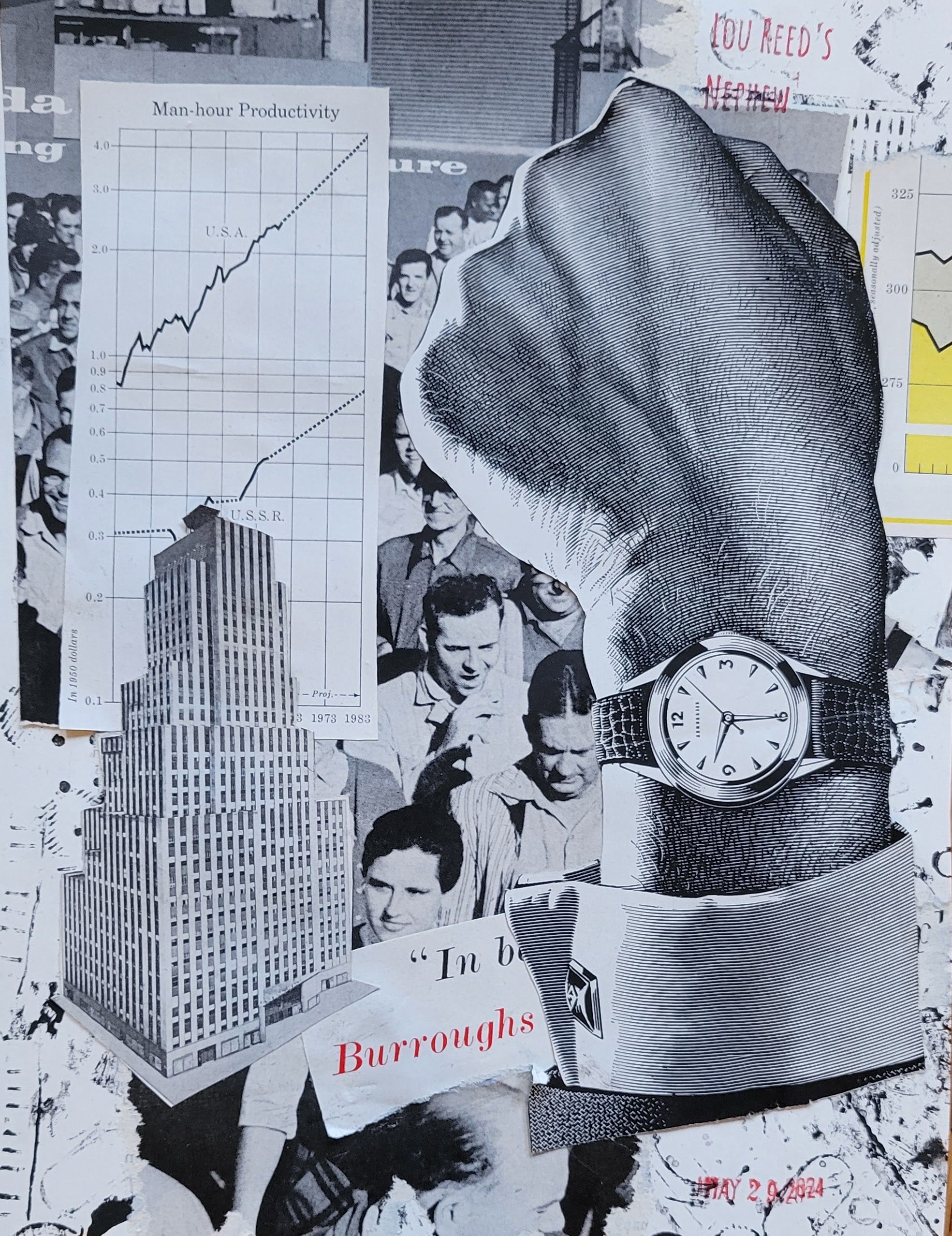
(Author’s note: I recently reconnected with an old acquaintance who will be familiar to longtime readers. If you are not familiar with our history, this is a good place to start.)
“It was quite a challenge to get to you,” I said when Lou Reed’s Nephew finally appeared on the Zoom. His background was blurred. Mine wasn’t and I felt vulnerable. He was four minutes late, one minute short of the customary “Is now still a good time?” email. He knew what he was doing.
Though he had given me a link to his calendar after his Manic Monday performance, EasyOut—the outplacement service to which I was contractually entitled—required me to sit through a series of asynchronous videos before receiving a personal identification number that would allow me to book an in-person session (to which I was contractually entitled). The videos had titles like “Branding the Brand Named Me” and “57 Numbers to Delete from Your Resume, All of Which Are Your Age.” I ran them muted in the background while I did the dishes, jiggling my mouse while I waited for the sink to drain.
“I said, it was quite a challenge to get to you,” I repeated loudly, as if I were speaking to an elderly person, once Lou Reed’s Nephew got his computer to recognize his headphones. This never happened on Star Trek.
“EasyOut made me jump through hoops!” I said.
“EasyOut?” he said. “I don’t work with them anymore.”
This was annoying. That I had wasted time—of which I now had too much—running muted instructional videos on my computer. I took a moment to examine him and compose myself. I had only ever talked to him in person—in those last normal years?—and had yet to regard him in the Zoomosphere, which offers a certain reflective distance. Though the other person can see you, they see you askance—or seem to—as they look into the representation of your eyes, the glowing white pinhole above their screen, though not into your eyes in fact. This offset creates a two-way partial voyeurism, where each person sees the other but does not themselves feel completely seen. I was okay with not being seen, after more than a decade of “showing up,” but younger people were starved for appearing and for confirmation of these appearances. They wanted and needed to be seen. God used to handle all this seeing, but now he was gone. We would have to do it.
I sunk into my illusion of invisibility to refamiliarize myself with Lou Reed’s Nephew’s face. It was still narrow, like his nose. He no longer wore glasses, having perhaps lost some of the youthful bravado that enabled him to glorify his defects. His dark hair showed flecks of gray. His features no longer held the hydration of youth. They had set and hardened. Ozempic could not be ruled out.
“You’re not working with EasyOut anymore?” I said. The Albanian must have been crushed. I hadn’t been to the EasyOut office in weeks and was hopeful that my physical withdrawal from the office habitat was complete. Though I still couldn’t bring myself to go to a movie in the middle of the day—during “business” hours—time was losing its edges. I was de-professionalizing. Occasionally I wandered around the apartment like a confused bear looking for his tri-color ball.
“I mean, I never really did,” he said. “Places like that subcontract everything to people like me.”
“People like you?” I said.
“Experts,” he said.
I waited for air quotes to fly in from the sides of the screen, but they never did. He was serious, as always.
“Well we haven’t spoken in years,” I said. “What have you become an expert in?”
“Expertise,” he said.
This made sense, or a certain sort of sense. The sense I had become accustomed to for several months in 2013, and with which I was no become reacquainted.
“I see,” he said.
“Consulting is where it’s at,” he said. “Expert expertise is what it is, really. I’m working on a book about it.”
I was surprised that he had not asked me about my book again. This was the first evidence that it was still on his mind. This was common, upon people discovering that you had a book being published by someone other than yourself. They had no idea how fragile this state was, how unlikely that it had arisen at all, and that you lived every waking moment waiting for it to somehow fall apart. That the book would be cancelled and you would no longer be special in the way these people perceived you to be, though you knew that you weren’t while simultaneously enjoying and resenting their thinking so.
“What’s it called?” I asked. It was the only thing to say at this point.
“The Four Disagreements,” he said.
“I see,” I said. “Like the Don Miguel Ruiz. Have you spoken to a lawyer?”
“I have,” he said, “Ginger Rogers makes it alright. Fair use.” I understood exactly what he meant, having recently discussed this with my own lawyer as it pertained to a (currently) forthcoming book that referred to a famous musician in the title and, indeed, obsessively throughout. Ms. Rogers had sued MGM over the production and distribution of the 1986 Federico Fellini film Ginger and Fred, but the courts ruled that Fellini’s right to expression outweighed Rogers’ right to trademark. Score one for the avant-garde.
“What are the disagreements?” I said.
“I haven’t finalized them,” he said. “But it won’t be hard. The disagreements already exist. in any organization and likely in any entity in the universe. The consultant just needs to find and name them to make themselves indispensable.”
“Can you give me an example?” It was always useful to ask Lou Reed’s Nephew for examples. His ideas could be abstract and elusive.
“Of course,” he said. “The first disagreement is the disagreement over centralization vs. decentralization.”
“Can you be more explicit?”
“Yes. In any organization that might come to you for advice, you will find that things are either centralized, and therefore slow and rigid, or wildly decentralized and out of control.”
“And you, as an expert, have a view on which of these is better?”
“I certainly do not!” he said. “I just know what to recommend once I’ve determined what state the organization is currently in.”
“And that is?”
“If it is together, take it apart. If it is apart, put it back together.”
“That’s it?”
“That is it,” he said.
“And this creates value, you’ve found?”
“I have no idea. But the reversal of tension, as in storytelling, creates a certain … excitement. A sensation, in the mass hysterical sense. Things are happening and everyone gets behind them and watches intently as value flows from one part of the organization to another. You are a genius and a hero: the person who knew to put things together or take them apart, whichever the case may be.”
“Until?”
“Until the newness wears off and some people begin to realize, and then become bold or ambitious enough to say out loud, that it appears—perhaps—that this realignment has not actually created or unlocked any new value. It has simply moved old value around while enriching you, the consultant.”
“I see,” I said. “That seems like a bad moment.”
“Oh it is,” he said. “A real challenge, as they say.”
“So what do you do then?”
“You move onto the next disagreement,” he said.
“Which is?”
“It looks like we’re out of time,” he said, “So that will have to wait until our next session. I refuse to pay for Zoom, so this will shut …”
“You don’t know what it is yet, do you?” I said.
The Zoom ended before he heard me.