

The Known Unknowns
Why last month's prediction went so wrong.


Oh, Icarus. Did you fly your homemade data contraption too close to the sun?
Yes. I’m afraid I did.
To recall: Flush from predicting that Steerforth’s A Resistance History of the United States would be an indie hit—it made the Times’ list and currently sits at #5 on the Independent Publishers Caucus list, where it has spent six weeks—I made a similar prediction about Melville House’s Trash!: A Garbageman’s Story, a buzzy memoir translated from the French. Specifically:
I think Trash! will debut in the top 5 on the relevant ABA and IPC lists and in the #5-10 range on the Times’ Combined Nonfiction list. Be sure to subscribe to find out how I did.
Well here you are. How did I do? I blew it. Trash! did not make any of these lists. Why? The answer is channel mix, which I was aware of, though I grossly underestimated its impact.
What, exactly, was I thinking?
I was thinking that Trash!, a non-fiction paperback with indie, socially conscious appeal, was out-performing Resistance History at Amazon, which was and is true.
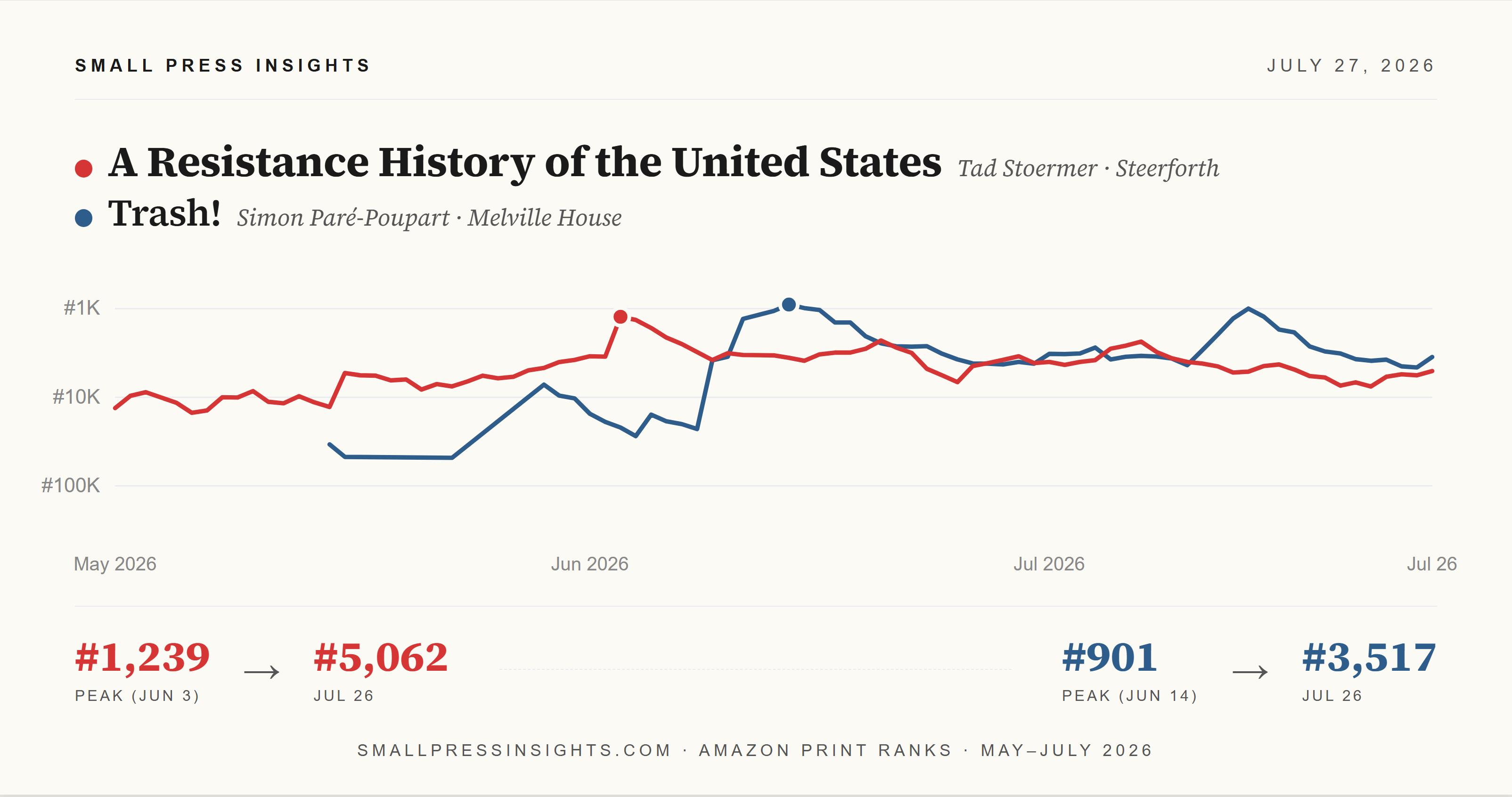
It peaked higher, stayed higher, and is higher today. But Amazon is not the whole market, and how well a book will do at the indies compared to Amazon is guesswork, and I guessed wrong. The known unknowns got me. A Resistance History of the United States is selling better in sales channels I cannot see—by which I mean indie bookstores, B&N, etc.—even while Trash! sells better at Amazon.
This could be for a number of reasons, from the fact that Tad Stoermer has such a big social media platform that indies are ordering more, to the possibility that indies are having trouble stocking the Melville House title. (Both presses are distributed by PRH.) Bookshop, which is powered by Ingram, is showing Trash! as on backorder—which is likely what indies will see—while you can buy it right away on Amazon. That could lead to this sort of outcome. (I sent a note to Melville House for their take, but did not hear back.) If you’re in the trade and have any first-hand insight about how Trash! is selling in your store, feel free to drop it in comments or send me a note.
In the meantime, I will be more … cautious when it comes to called shots.
Now you might say, “That’s fine, but clearly your methodology stinks! It is entirely reliant on Amazon rank, which does not tell the whole story.”
That is true. But the paradox of Amazon is that, as the giant in the market, it is also the only cheap source of relative sales information for the entire market because it assigns a sales rank to every single print book in its catalog. Neither Barnes & Noble nor Bookshop does this, so the only public signals for the indie market are curated lists like the IPC’s or the ABA’s, which only report top sellers. (I use the IPC’s because it is limited to indie books at indie bookstores, while the ABA’s list is dominated by Big 5 titles.) Because of this gap, Amazon gains an additional advantage by dominating the public data conversation.
Meanwhile, SPI Keeps Improving!
As I previously warned, SPI development will be “slow, thoughtful, and clear” to keep things from getting all junked up. That said, I’ve added a useful press filter on the Top Sellers at Amazon tab so you can quickly see what’s charting from a particular press that you are researching or, perhaps, run. Shout out to former PRH analyst Talia Berday-Sacks for encouraging me to prioritize this feature and helping me think it through.
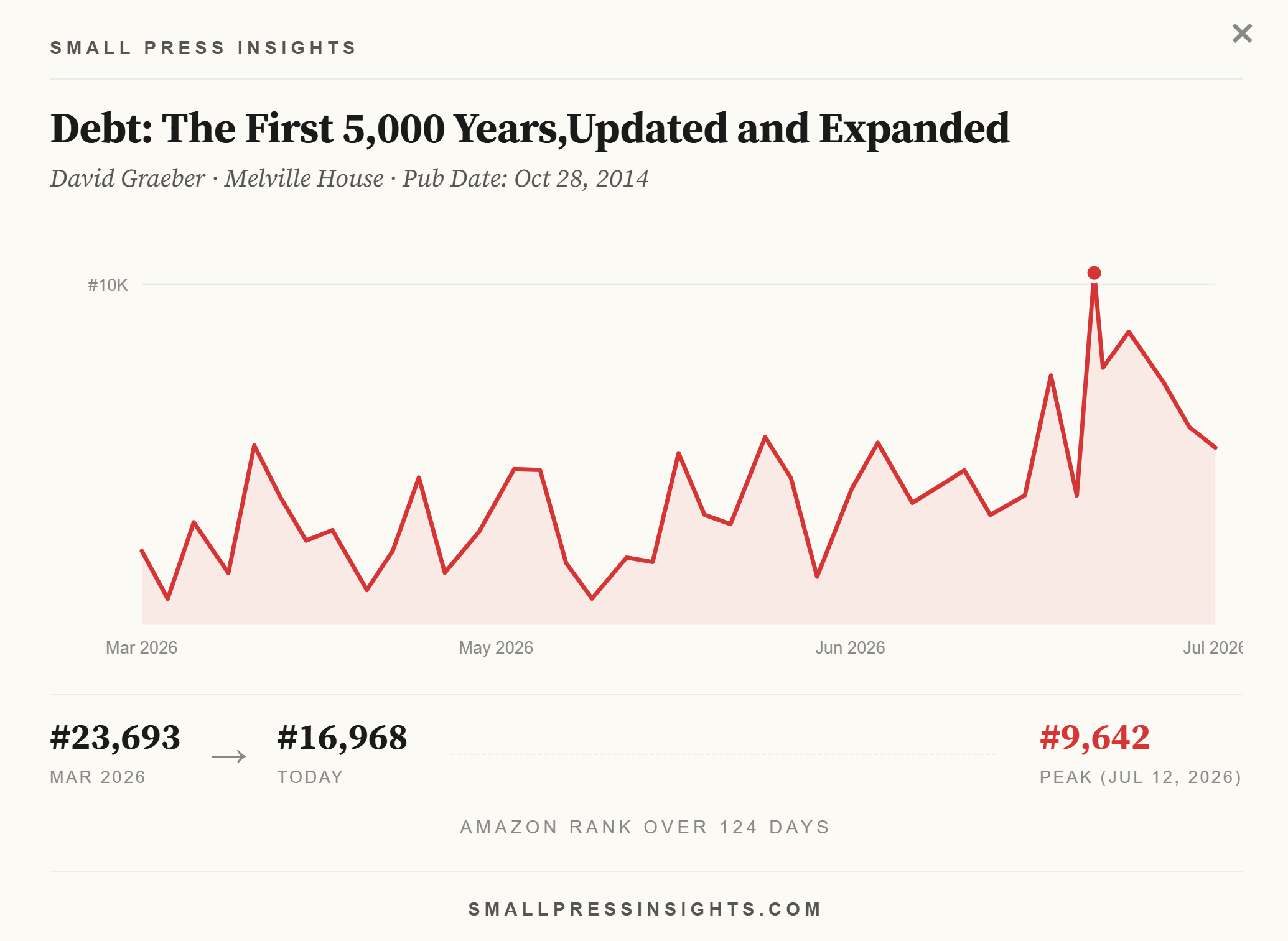
Here is a link to the page filtered to Melville House. You can bookmark the page for your favorite press. And, of course, you can click on any line to see the Amazon rank history for any title, like so:
August: Maximalism’s Last Stand?
Chastened by my June miss on Trash!, I will avoid big predictions and humbly share the books that are ranking well at Amazon ahead of their August on-sale dates.
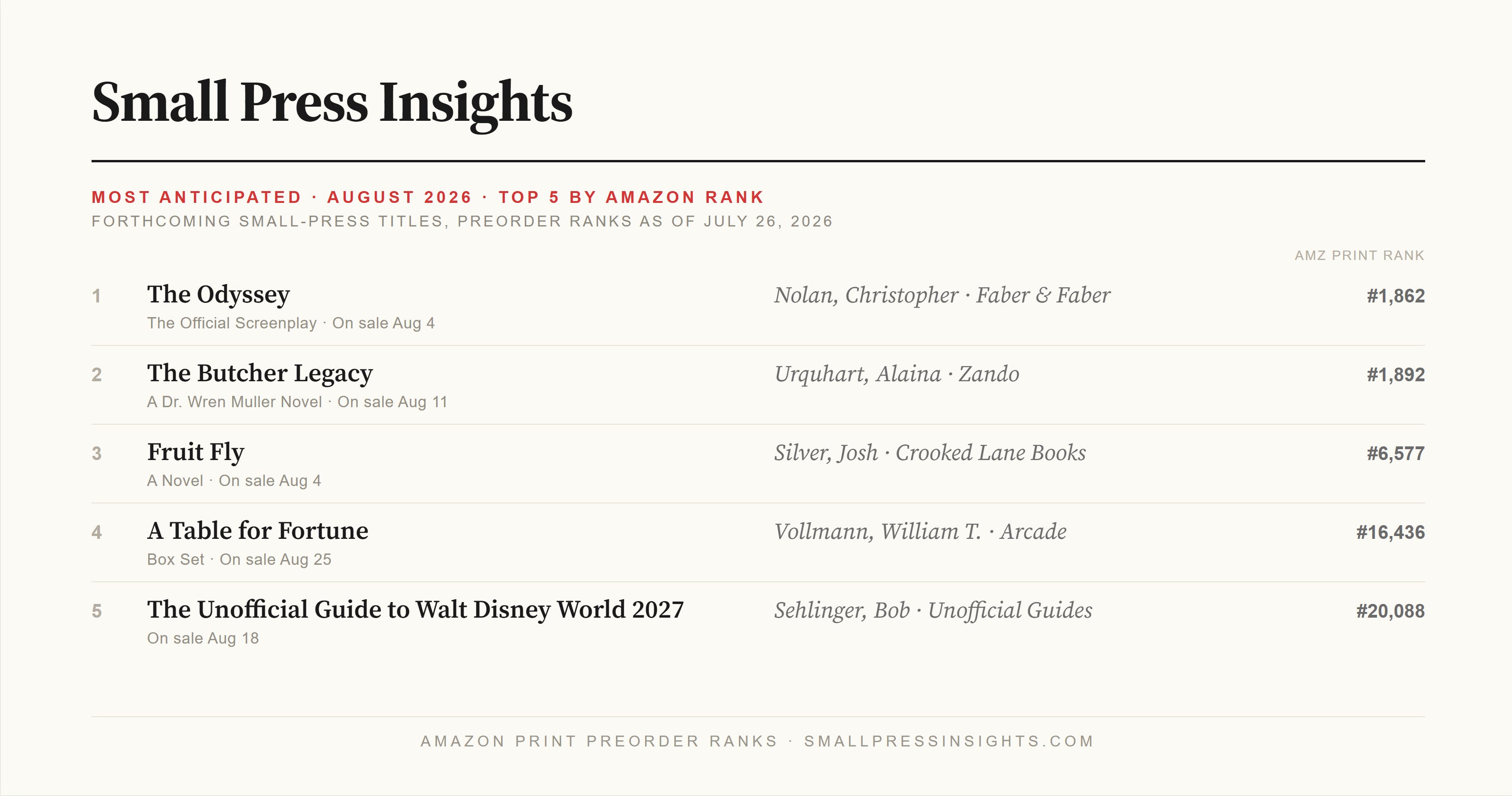
This is a pretty good snapshot of publishing right now. Summer blockbuster by-product, a vacation guide, a thriller series, a satire set in the publishing industry, and a $200 box set from a generational genius, published by the most divisive small press in America. In other words, it will be interesting to see how A Table for Fortune, the latest (and perhaps last, due to his failing health) from William Vollmann, plays out. It’s been ranking well, despite being four volumes and 3000+ pages long. This is the kind of book that the mainstream book press normally rallies around in the name of Great American Novelizing, but will the fact that it is published by Skyhorse (via its Arcade literary imprint)—who gave Steve Bannon a whole imprint to publish useful idiocy like Unhumans: The Secret History of Communist Revolutions (and How to Crush Them)—keep them away? Will it sell anyway?
Since his dazzling debut, 1987’s You Bright and Risen Angels—the first and last I’ve personally read—Vollmann has proven himself to be the most uncompromising of the Generation Jones maximalists, a cohort that includes Richard Powers, Jonathan Franzen, and David Foster Wallace. The echo-Pynchons. The Metropolitan Review has the definitive account of how Viking eventually gave up on him—followed by Grove Atlantic, New Directions, and NYRB—and his career is basically a Rorschach test on whether you think it is po-mo maximalism or American publishing that has lost its way. (I must confess, on recently reading Gaddis’ foundational The Recognitions, it occurred to me that it could only have been published during a period of artificially low competition, a Golden Age of attention protectionism. But then I prefer White Noise to Underworld.)
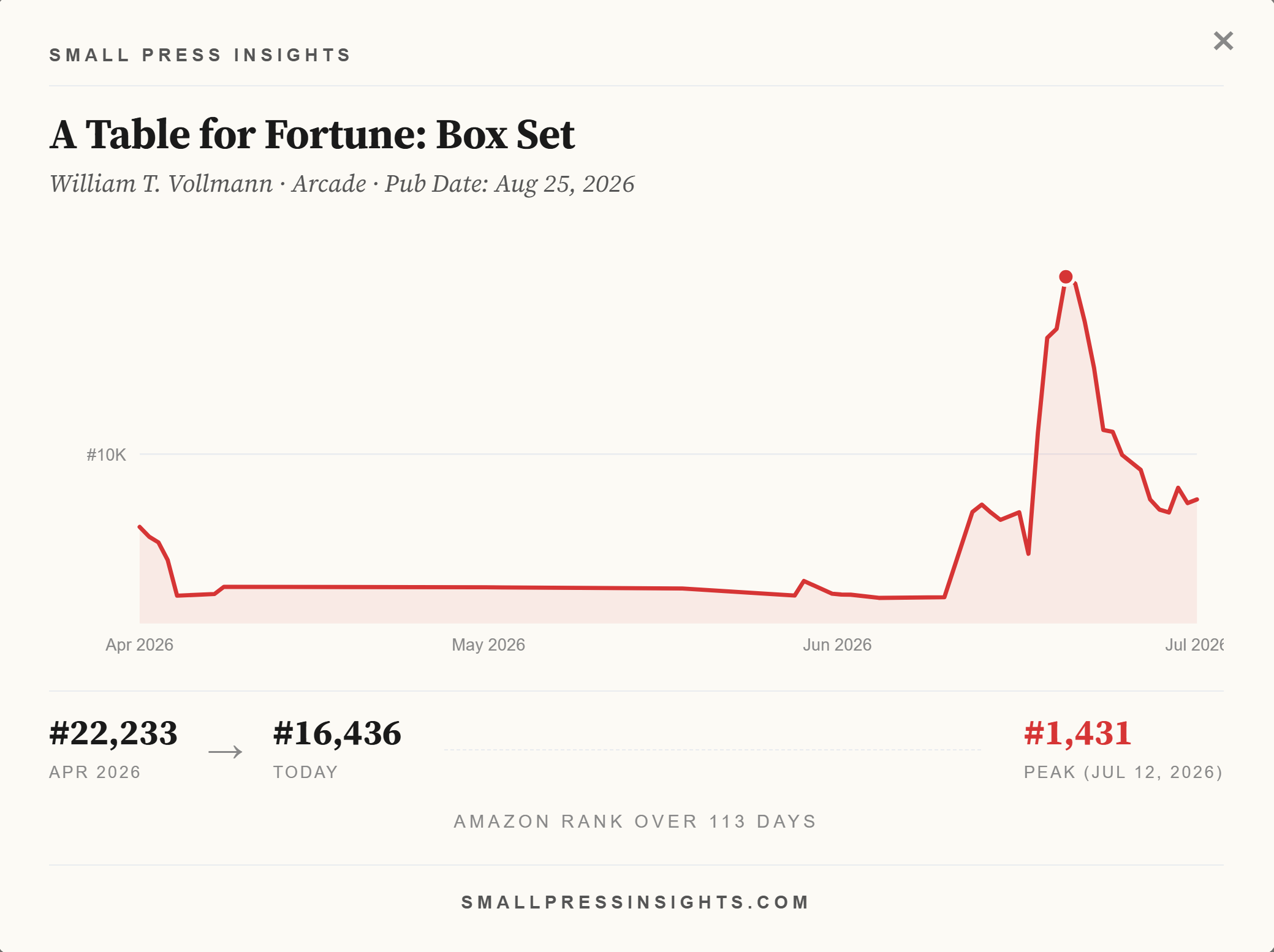
Publisher Tony Lyons’ libertarianism is nutty and extreme, but for that very reason I don’t see any way to avoid Arcade on moral grounds without missing out on important writing. (Joyce was first published by a pornographer after all.) I’m currently enjoying Emmalea Russo’s art world satire The Moon Papers, about an art collective bent on launching a second moon, with all the Baudrillardian hijinx that entails. Since Lyons will publish anything, he might well (eventually) publish a Pulitzer or National Book Award or Nobel-prize winner—if those entities will permit it—and I’m sure he enjoys the dilemma this Vollmann deluxe edition puts them in. Get the popcorn ready for August 25.
Elsewhere
A few weeks ago, I joined Joe and Elly on The People’s Guide to Publishing Podcast, to discuss Small Press Insights. What it is, why I built it, and how many books you have to sell to be a “bestseller” at Amazon, which I also discussed in last month’s column. Here is the episode: